
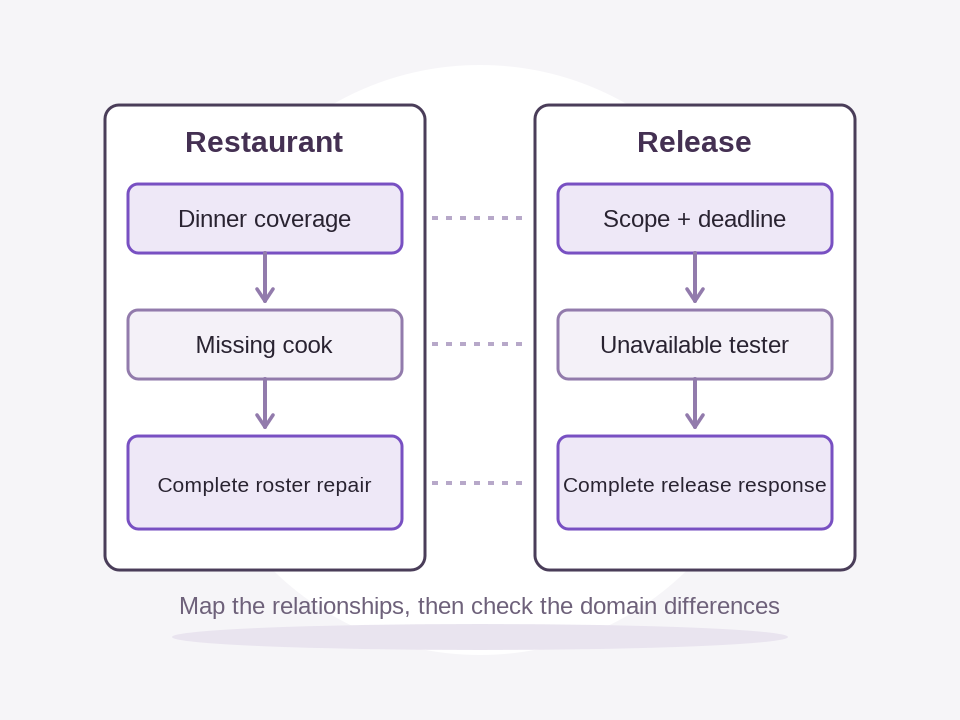
A restaurant callout and an at-risk software release share no obvious vocabulary. Both can require repairing an existing commitment with scarce qualified capacity. Recognizing that structure helps someone ask better questions before choosing a tool or copying a workflow.
A pattern name is useful when you can explain why it fits and where the resemblance ends. Start with the decision's relationships, rather than matching its industry or the words people use.
A problem family describes a recurring difficulty, such as allocating scarce qualified capacity. A decision pattern describes an approach to organizing the choice. The same family can admit several approaches, and an approach can apply across different domains.
Identify the consequential choice.
Ask who needs to decide, what they could do differently and what happens if they get it wrong. “Understand the shipment” is broad. “Choose a supported shipment response before reservation closes” exposes the action, deadline and stakes.
Some questions support a later decision without choosing an action themselves. Establishing which faults the observations imply is a judgment about evidence. It can define corrective work, but it does not select a supplier or authorize expense.
Separate what remains fixed from what can vary.
State the obligation, scope, operating facts and decision boundaries. Then identify the choices the comparison is allowed to change. The original promise must remain visible when comparing responses that revise it.
For Nina's release, the baseline retains core functionality and reporting, the original cutoff and the $500 additional-expense limit. Additional qualified help, deferred reporting and a later release represent different responses. An accepted scope revision changes a declared condition; quietly removing reporting changes the question without acknowledging it.
Also distinguish a planned choice from an uncertain observation. A manager can choose an arrangement. They cannot choose which interpretation of fixed evidence is true merely because its remedy is cheaper.
Ask what a candidate represents.
| Assessment | Candidate meaning | Judgment sought |
|---|---|---|
| Evidence | An interpretation compatible with fixed observations. | Does an admissible interpretation exist, and do admissible interpretations agree on the required answer? |
| Commitment | A complete supplied operating arrangement. | Which candidates meet the declared obligations? |
| Information value | An investigation with responses to its possible reports. | Is its modeled outcome better than the supported outside option? |
From Arrangements to Assessments explains those assessment contracts. Similar tables or graphs do not make their conclusions interchangeable. In particular, a planned rehearsal is neither evidence that it occurred nor a calculated reason to purchase it.
Look for a recognizable relationship.
Use Make a Bounded Commitment when complete responses must satisfy connected conditions. Use Repair a Disrupted Commitment when changed facts undermine an existing promise and repairs may affect other obligations.
Use Diagnose Before Correcting when different supported explanations imply different remedies. Use Investigate Before Acting when obtaining information is itself a proposed commitment whose results could change a later response.
A situation can use several patterns. Leah first establishes the gift-kit faults, then compares complete corrections. The decision structure connects those judgments without treating them as the same assessment.
Test the resemblance with a near miss.
“We need more staff” could mean capacity is insufficient, existing staff lack a qualification or someone is unavailable at the required time. An extra person resolves none of those conditions unless their actual assignment fits. “We need a test” could mean a mandatory operating check, diagnosis or an optional study. Identify what the result must establish before naming the pattern.
A first roster and a disrupted published roster can both require feasibility reasoning. Only the latter necessarily carries an existing assignment's stability and recovery obligations. A forecast of customer attendance may inform spending; it does not establish a deployment's operating fit.
Predict a variation before revealing its result.
Try the disrupted-commitment experiment. Before revealing each finding, predict what a qualified tester, a mismatched qualification, an accepted scope reduction or an unknown estimate should change. Then compare the restaurant variation: what corresponds to qualification and availability, and which conditions have different domain meanings?
Practice with an unfamiliar situation. State the choice, retained obligation, variable candidates, supporting facts and expected conclusion. Explain one reason your selected pattern fits and one condition that would require another approach. The goal is a justified mapping you can discuss and test.