
Before a booking cutoff, Maya could pay for a registration check that might enable cheaper freight. Before funding another promotion, Alex wants to know whether outreach actually creates additional business. Both face uncertainty, but “learn more” is an incomplete recommendation. We call the decision approach Investigate Before Acting.
Find information that could change a response.
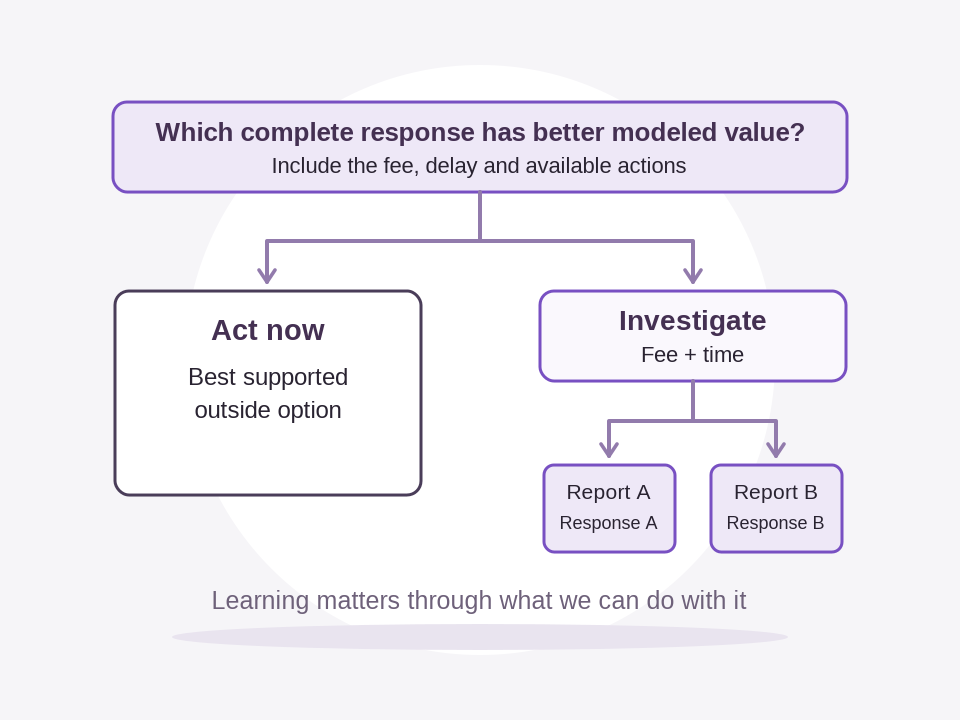
The signature is a consequential action available now, a proposed investigation, and different possible responses after its findings arrive. Learning consumes money, time or another resource. Its value depends on what the team can still do with the answer.
Start with the outside option: what supported response could the team take without this investigation? Then identify which result could change that response. An interesting answer received after the action window closes may have little value for the immediate decision.
Compare complete investigation-and-response alternatives.
Specify the investigation, possible reports, numerical premises where needed, response timing and complete actions available afterward. Count its cost once. Compare modeled outcomes against the best supported outside option using the declared objective.
The Information-Value Assessment makes this comparison explicit. Its candidates represent an investigation together with responses to possible results. Supporting commitment assessments can establish whether those responses remain feasible. A probability estimate alone answers neither question.
See an implemented shipment comparison.
In Maya's Python integration, Backup meets the recorded requirements for $6,000. Direct costs $4,000 but requires current scoped registration confirmation. A Python model supplies a registration estimate; Decision Lab's planning and information-value assessments connect it to available shipment responses.
Under the fictional, accepted numerical assumptions, a timely $200 check produces $5,772.96 expected complete expense: $227.04 less than Backup now. Change only the fee to $2,500 and checking costs $8,072.96 in expectation, so the fallback is preferred. A result arriving after the reservation cutoff also fails to support a timely response.
The estimate is unchanged in the fee comparison. The recommendation changes because learning's value depends on its expense and the remaining actions. A registration probability never replaces the actual confirmation required by Direct.
Recognize a proposed variation without overstating it.
In Alex's promotion-learning brief, a $200 deployment needs five genuinely additional guests at $40 contribution each to cover expense. That threshold does not establish whether promotion causes enough additional attendance or retained contribution.
Alex and the owner identify the spending question, a comparison with no additional push and the records a credible study would need. The approved study design, data and information-value calculation do not yet exist. This is a proposed application of the decision approach, not a second implemented learning assessment or a measured promotion effect.
Required checks and useful investigations differ.
A mandatory qualification or safety check cannot simply be omitted because a financial calculation prefers skipping it. Its governing requirement must be respected. Likewise, a diagnostic observation already in hand belongs to the current evidence basis; deciding what it establishes differs from deciding whether to purchase another observation.
Preserve the assumptions behind the recommendation.
Expected improvement is conditional on the admitted outcomes, probability basis, objective and available responses. It is not guaranteed savings or total profit. Poorly supported probabilities may prevent the comparison from being made responsibly.
Follow Diagnose Before Correcting when the immediate question concerns what current observations establish. Use Make a Bounded Commitment to check the actions a proposed investigation is meant to enable.