
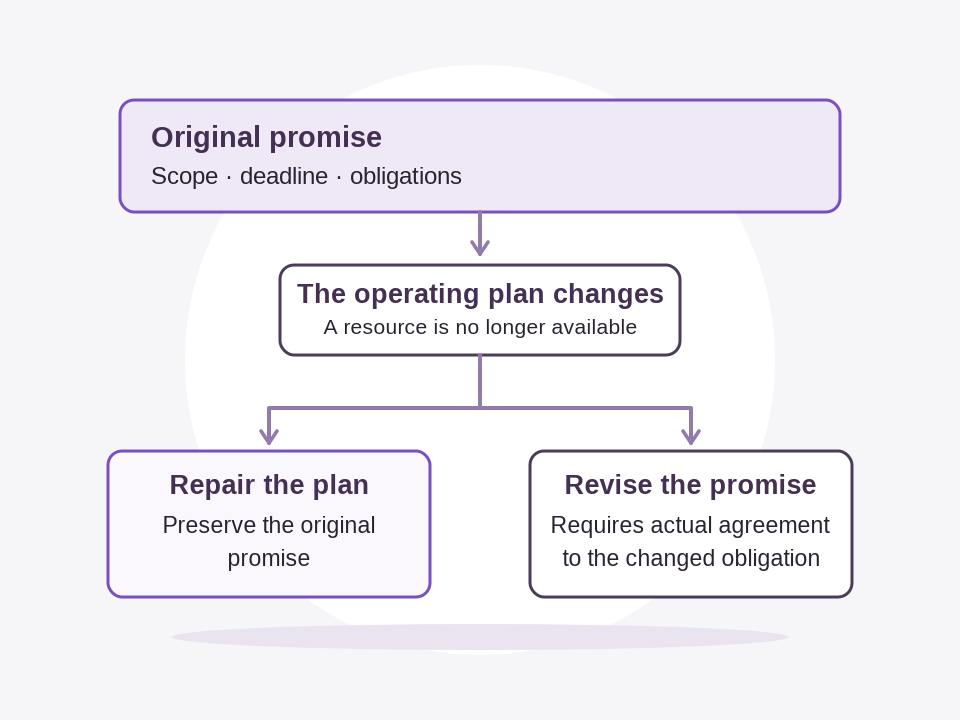
A cook calls out after the roster is published. A release has more validation work than the remaining qualified capacity can absorb. Both situations begin with an existing commitment whose operating basis has changed. We call the recurring decision approach Repair a Disrupted Commitment.
The useful question is broader than filling the visible gap: which complete response can recover the commitment, and which proposed responses would change what was promised?
Find the promise behind the disruption.
Look for an original obligation, a changed fact that undermines its current plan, and several possible repairs. The signature includes dependencies outside the immediate problem. Moving a cook may uncover another service. Removing reporting may make a release smaller than the customer agreed.
Write the original scope, deadline and required conditions separately from proposed changes. A response that fits its own revised schedule can still fail to preserve the original promise.
Compare complete repairs against the retained obligation.
Retain the original commitment and the current basis. Construct complete repair candidates, including their consequences for other assignments, expense and timing. Use a Commitment Assessment to establish which supplied responses meet the declared requirements.
Keep feasibility and preference separate. If two repairs pass, an explicit policy can favor cost or stability. If a repair changes the promise, identify who must agree and the scope of that agreement. A business agreement to change deliverables is distinct from calculating or inspecting an assessment.
See the structure in a release and a roster.
In Nina's release recovery, twenty hours of QA remain and the existing qualified allocation supplies sixteen before handoff. A $400 independent-regression package transfers four hours of suitable work to qualified external help. In the baseline it is the only supplied arrangement meeting the requirements while preserving the original scope and cutoff.
The app establishes feasibility without ranking. Nina explains her preference: preserve the promised scope and date within the recorded $500 expense limit. The supported schedule finishes at the boundary, so extra work or changed availability needs reassessment.
In Elena's roster repair, Nora cannot work Saturday's 6–10 p.m. cooking shift. One repair uses relief cook Rowan; another coordinates changes across Saturday and Sunday. Both can pass with Rowan available until 10. Change only that availability to 8, and the relief repair fails while the coordinated repair remains feasible. The complete roster prevents a local fix from hiding another gap.
Treat a changed promise as an explicit variation.
“Revise the Promise” is a variation of this approach. In Nina's reduced-release comparison, deferring reporting requires explicit acceptance of the scope revision. Completing core functionality by the cutoff does not itself establish that agreement.
Changing a roster's service requirement would similarly change what the repair is being asked to preserve. State that change openly rather than lowering a condition until a preferred candidate passes.
Recognize when recovery is the wrong frame.
A team planning its first roster has no disrupted published promise to recover. It may still use Make a Bounded Commitment, but the stability costs and responsibility for revising existing promises differ. If the suspected problem is not established, diagnosis may need to come first.
A repair proposal still needs operating follow-through.
The finding covers supplied alternatives and declared conditions. It neither invents every possible repair nor books external help or secures employees' agreement. Try the disrupted-commitment experiment to see how availability, qualification and an accepted scope change alter the answer without changing the underlying approach.