
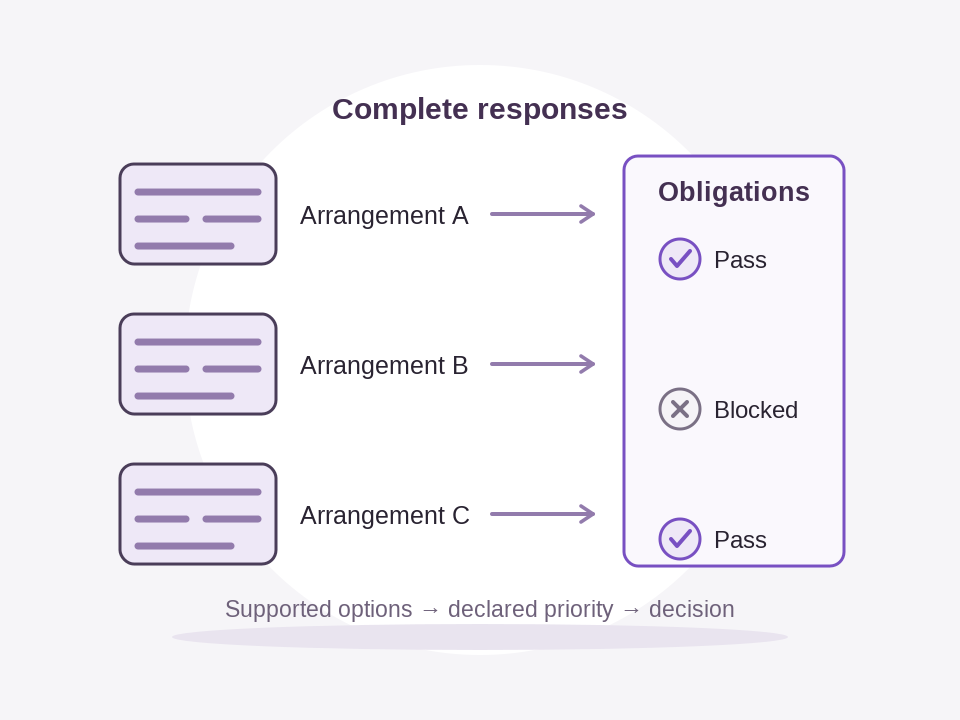
Maya has to protect a launch. Alex has to decide whether to send staff out to promote a quiet venue. Their work looks different, but both need a complete operating response that fits explicit conditions before making a commitment. We call this decision pattern Make a Bounded Commitment.
This is our name for a demonstrated way to organize a decision. It connects supporting assessments with a person's choice and the organization's operating process. It is not a new SDK assessment type.
Recognize a commitment with connected conditions.
The signature is a choice among complete responses whose parts must work together: assigned resources, quantities, locations, timing, expense and necessary permission. There is an obligation or operating objective to protect, and limits the decision maker must respect.
A low price is insufficient if the route misses the receiving window. Enough promoters are insufficient if sending them outside leaves the venue understaffed. The important unit of comparison is the complete arrangement, rather than each attractive part considered alone.
Compare operating fit before choosing.
State the obligation, supply complete candidates and assess them against the same current facts. Identify missing information separately from failed conditions. If several candidates pass, apply a declared preference or leave the tradeoff to the decision maker. Preserve the conditions that support the resulting proposal.
The Commitment Assessment supplies the bounded feasibility judgment. Choosing, authorizing and carrying out an arrangement require the relevant people and operating records. Inspecting a calculated option performs none of those actions.
See the structure in two domains.
In Maya's shipment comparison, Direct costs $4,000 but depends on unresolved transportation registration. Backup costs $6,000 and meets the requirements in both admitted registration states. A genuine current scoped confirmation establishes registration and lets Direct enter the complete cost-first comparison. The quotes stay fixed; the supporting evidence changes.
In Alex's promotion decision, five staff are available and four must remain inside. Sending two fails coverage. Sending one and holding both meet the operating requirements. Alex can consider a $200 one-person push while customer response remains unknown. After another callout leaves four available, he keeps the team inside.
The variation matters. Shipping applies a declared ranking among passing arrangements. The promotion calculation exposes operating fit and conditional expense-recovery thresholds; it does not establish a profit ranking. The calculation leaves that spending judgment to Alex.
A forecast is a different answer.
“How many customers will attend?” asks for an estimate. It supplies neither a complete deployment nor evidence that the proposed staffing and timing are allowed. A forecast may inform a commitment, but it cannot replace the operating comparison. Likewise, a feasible deployment does not establish that anyone will respond.
Keep the conclusion attached to its basis.
A passing finding concerns the supplied candidates, represented conditions and current inputs. It does not establish that every possible response was considered, that records are authentic or that the work has happened. When a booking window, permission or availability changes, reassess before using the earlier finding as current support.
Recognize what the next question needs.
If an existing promise has been disrupted, use Repair a Disrupted Commitment to keep that promise visible. If a missing fact could change the choice, consider Investigate Before Acting. The pattern library names the approaches; the linked use cases show their operating detail.