
A release is due Monday at 5 p.m. Its delivery manager needs a commitment she can take to the customer. Additional help, an accepted reduction in scope and an unanswered workload estimate change that conversation in different ways. Can you predict which conclusion each change supports?
Keep the question fixed while the facts change.
The decision pattern is Repair a Disrupted Commitment. A promise is at risk; the team compares complete responses before making another promise. Its supporting Commitment Assessment checks each supplied arrangement against its applicable obligations. Passing, preferring and carrying out an arrangement remain separate.
Each exercise below begins from the same release baseline. Changes do not accumulate between exercises. Predict the result, then compare your reasoning with the retained calculation. With JavaScript disabled, open each worked comparison directly.
These are fictional, verified worked comparisons from one configured workflow, not live assessments of your business. The workflow compares four supplied complete arrangements and declares no ranking. The exercise does not execute Decision Lab in this page.
1. Start with a supported recovery
Starting point: No change: this is the baseline.
Recorded basis: The promised release includes core functionality and reporting by Monday at 5 p.m. Core QA is 720 minutes; reporting QA is 480 minutes. Additional qualified QA costs $400 within a $500 limit. The two proposed revisions have not been accepted.
One supplied arrangement preserves the original promise.
The fixed independent-regression package can transfer to the qualified external tester within the recorded window. Full release with additional QA passes at $400, ready Monday at 5 p.m. Existing QA alone misses the deadline and lacks a required working interval. Core-only and later delivery are still unaccepted revisions.
| Complete arrangement | Finding and commitment basis | Additional expense / handoff ready |
|---|---|---|
| Full release with existing QA | Blocked Original scope and deadline | $0 Monday, 9 p.m. |
| Core release with reporting deferred | Blocked Defer reporting | $0 Monday, 1 p.m. |
| Full release with additional qualified QA | Passes: original promise Original scope and deadline | $400 Monday, 5 p.m. |
| Full release on the proposed later date | Blocked Later deadline | $0 Tuesday, 10 a.m. |
What transfers: A feasible complete arrangement supports a commitment. It does not select it, reserve the tester or establish actual delivery.
Next business step: Discuss the supported recovery and confirm that its operating records remain current.
Read the worked comparison
One supplied arrangement preserves the original promise.
The fixed independent-regression package can transfer to the qualified external tester within the recorded window. Full release with additional QA passes at $400, ready Monday at 5 p.m. Existing QA alone misses the deadline and lacks a required working interval. Core-only and later delivery are still unaccepted revisions.
| Complete arrangement | Finding and commitment basis | Additional expense / handoff ready |
|---|---|---|
| Full release with existing QA | Blocked Original scope and deadline | $0 Monday, 9 p.m. |
| Core release with reporting deferred | Blocked Defer reporting | $0 Monday, 1 p.m. |
| Full release with additional qualified QA | Passes: original promise Original scope and deadline | $400 Monday, 5 p.m. |
| Full release on the proposed later date | Blocked Later deadline | $0 Tuesday, 10 a.m. |
What transfers: A feasible complete arrangement supports a commitment. It does not select it, reserve the tester or establish actual delivery.
Next business step: Discuss the supported recovery and confirm that its operating records remain current.
2. Change the accepted scope
Changed fact: Change only the recorded acceptance of deferring reporting: false → true.
Held fixed: Restore the baseline first. Keep the original promise, workloads, tester qualification, working intervals, fee and expense limit unchanged. The later deadline is still unaccepted.
Two arrangements pass, against different commitments.
Core-only is ready Monday at 1 p.m. and now meets an explicitly accepted revised commitment. Additional QA still preserves the original full release by 5 p.m. Acceptance changes the commitment against which core-only is assessed; it does not make the omitted reporting feature delivered.
| Complete arrangement | Finding and commitment basis | Additional expense / handoff ready |
|---|---|---|
| Full release with existing QA | Blocked Original scope and deadline | $0 Monday, 9 p.m. |
| Core release with reporting deferred | Passes: accepted revision Defer reporting | $0 Monday, 1 p.m. |
| Full release with additional qualified QA | Passes: original promise Original scope and deadline | $400 Monday, 5 p.m. |
| Full release on the proposed later date | Blocked Later deadline | $0 Tuesday, 10 a.m. |
What transfers: Repairing the original promise and agreeing to a revised promise are different decisions. A feasible revision never silently becomes fulfillment of the original scope.
Next business step: Compare the consequences of the supported alternatives. This model declares no priority or preferred arrangement.
Read the worked comparison
Two arrangements pass, against different commitments.
Core-only is ready Monday at 1 p.m. and now meets an explicitly accepted revised commitment. Additional QA still preserves the original full release by 5 p.m. Acceptance changes the commitment against which core-only is assessed; it does not make the omitted reporting feature delivered.
| Complete arrangement | Finding and commitment basis | Additional expense / handoff ready |
|---|---|---|
| Full release with existing QA | Blocked Original scope and deadline | $0 Monday, 9 p.m. |
| Core release with reporting deferred | Passes: accepted revision Defer reporting | $0 Monday, 1 p.m. |
| Full release with additional qualified QA | Passes: original promise Original scope and deadline | $400 Monday, 5 p.m. |
| Full release on the proposed later date | Blocked Later deadline | $0 Tuesday, 10 a.m. |
What transfers: Repairing the original promise and agreeing to a revised promise are different decisions. A feasible revision never silently becomes fulfillment of the original scope.
Next business step: Compare the consequences of the supported alternatives. This model declares no priority or preferred arrangement.
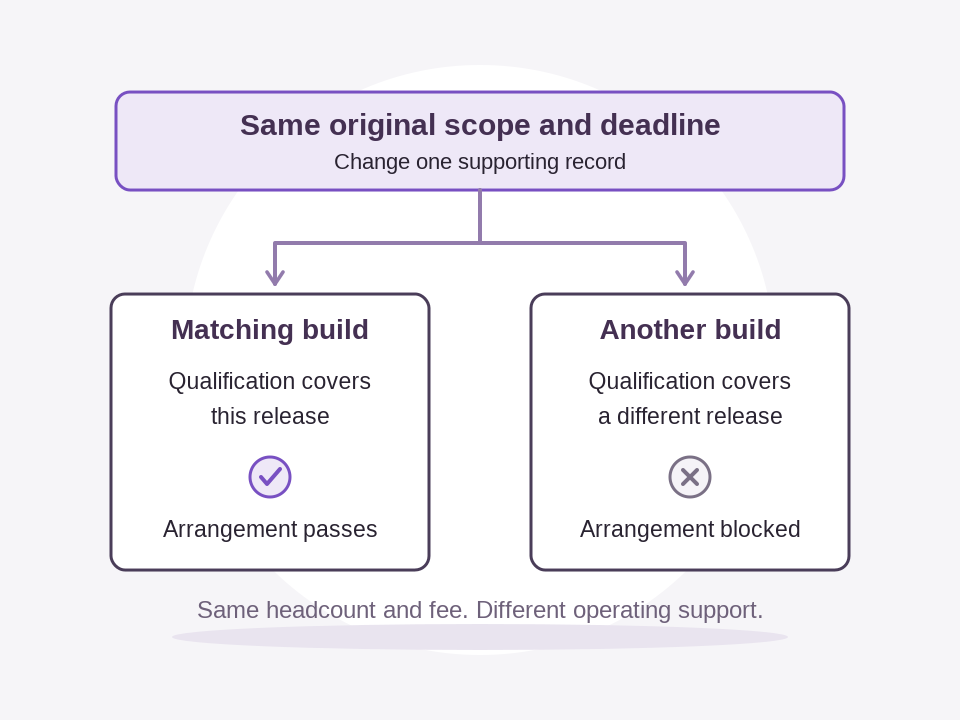
3. Change what the qualification covers
Changed fact: Change only the external qualification’s build: release-2026-11 → another-build.
Held fixed: Restore the baseline first, including unaccepted scope and date revisions. Keep the person, availability, price, workload and deadline unchanged.
No supplied arrangement passes.
The additional-help arrangement now fails its scoped qualification condition. Existing QA alone still fails timing and availability; reduced scope and later delivery remain unaccepted. The complete calculation rejects these four supplied arrangements under the recorded conditions.
| Complete arrangement | Finding and commitment basis | Additional expense / handoff ready |
|---|---|---|
| Full release with existing QA | Blocked Original scope and deadline | $0 Monday, 9 p.m. |
| Core release with reporting deferred | Blocked Defer reporting | $0 Monday, 1 p.m. |
| Full release with additional qualified QA | Blocked Original scope and deadline | $400 Monday, 5 p.m. |
| Full release on the proposed later date | Blocked Later deadline | $0 Tuesday, 10 a.m. |
What transfers: Usable capacity needs the right qualification for the actual work, build, environment and interval. This finding does not establish that every conceivable recovery is impossible.
Next business step: Obtain an applicable qualification record, propose another complete arrangement or reconsider the commitment through the normal business process.
Read the worked comparison
No supplied arrangement passes.
The additional-help arrangement now fails its scoped qualification condition. Existing QA alone still fails timing and availability; reduced scope and later delivery remain unaccepted. The complete calculation rejects these four supplied arrangements under the recorded conditions.
| Complete arrangement | Finding and commitment basis | Additional expense / handoff ready |
|---|---|---|
| Full release with existing QA | Blocked Original scope and deadline | $0 Monday, 9 p.m. |
| Core release with reporting deferred | Blocked Defer reporting | $0 Monday, 1 p.m. |
| Full release with additional qualified QA | Blocked Original scope and deadline | $400 Monday, 5 p.m. |
| Full release on the proposed later date | Blocked Later deadline | $0 Tuesday, 10 a.m. |
What transfers: Usable capacity needs the right qualification for the actual work, build, environment and interval. This finding does not establish that every conceivable recovery is impossible.
Next business step: Obtain an applicable qualification record, propose another complete arrangement or reconsider the commitment through the normal business process.
4. Remove a required estimate
Changed fact: Omit only the remaining core-QA estimate. Its answer is now unanswered.
Held fixed: Restore the baseline first. Preserve all other operating records, workloads and commitment facts. An omitted estimate is not zero effort.
The comparison needs information before it can be evaluated.
The native workflow performs no planning assessment. The planning step needs input and the decision summary is unknown. There is no current set of calculated passing or failing arrangements to interpret.
What transfers: Lacking an answer is different from establishing that no supplied arrangement works. In this bounded workflow, the required missing estimate leaves the whole comparison unresolved.
Next business step: Obtain and record a usable core-QA estimate, then calculate the comparison.
Read the worked comparison
The comparison needs information before it can be evaluated.
The native workflow performs no planning assessment. The planning step needs input and the decision summary is unknown. There is no current set of calculated passing or failing arrangements to interpret.
What transfers: Lacking an answer is different from establishing that no supplied arrangement works. In this bounded workflow, the required missing estimate leaves the whole comparison unresolved.
Next business step: Obtain and record a usable core-QA estimate, then calculate the comparison.
5. Try the structure in a different domain
A Saturday callout leaves Elena’s restaurant short of one cook. With Rowan available for the full dinner shift, two of four complete repairs pass: bring in Rowan, or coordinate changes across Saturday dinner and Sunday lunch. Now predict the effect of a shorter availability window.
Changed fact: Change only Rowan’s Saturday finish time from 10 p.m. to 8 p.m.
Held fixed: Saturday dinner still needs two qualified cooks from 6–10 p.m. The other services, employee records, pay quotes, $856 remaining-payroll limit and four complete repairs are unchanged. Compare without ranking.
The coordinated repair remains feasible; Rowan no longer covers the whole shift.
With full availability, the relief and coordinated repairs both pass. With the earlier finish, Rowan cannot cover 8–10 p.m.; the relief repair fails. The coordinated repair still covers the complete remaining roster. Leaving the gap and moving Theo alone continue to fail coverage.
What transfers: The shared relationship is qualified capacity covering the whole required interval. A restaurant still has its own roles, rest, hours and service conditions; a software qualification cannot stand in for a cooking qualification.
Next business step: Elena can take the coordinated proposal to the affected staff. The calculation does not obtain their agreement or publish the roster.
Full-availability native record · Short-availability native record
Read the worked comparison
The coordinated repair remains feasible; Rowan no longer covers the whole shift.
With full availability, the relief and coordinated repairs both pass. With the earlier finish, Rowan cannot cover 8–10 p.m.; the relief repair fails. The coordinated repair still covers the complete remaining roster. Leaving the gap and moving Theo alone continue to fail coverage.
What transfers: The shared relationship is qualified capacity covering the whole required interval. A restaurant still has its own roles, rest, hours and service conditions; a software qualification cannot stand in for a cooking qualification.
Next business step: Elena can take the coordinated proposal to the affected staff. The calculation does not obtain their agreement or publish the roster.
Full-availability native record · Short-availability native record
Explain the structure before naming the pattern.
Before opening the restaurant answer, try to explain it in one sentence: what is the obligation, what capacity is proposed, and which relationship decides whether that capacity is usable? Naming a familiar pattern is useful only when those relationships fit.
A different problem may need another assessment. If the central question is what conflicting observations establish, start with Evidence Assessment. If it is whether to pay for an investigation and act on its possible results, consider Information-Value Assessment. Checking one qualification inside a release plan does not automatically turn the entire task into either of those assessments.
Follow the people and records behind the comparisons.
Follow the release-recovery stories to see the customer promise, fixed independent-regression package and recorded scope amendment in the working app. Follow Elena’s dinner-coverage decision to see why repairing one shift must preserve the other services. The patterns transfer through compatible relationships; domain records retain their particular meanings.