
Leah has one day to prepare 120 gift kits. A printed code will not scan, and the campaign’s recipient journey may be broken. Replacing every part could waste the correction budget. Reprinting only the insert could leave a wrong destination untouched. Before she compares responses, she needs a defensible answer to a smaller question: what do the recorded checks actually establish?
The first temptation is to settle on a plausible story. Perhaps the printer caused everything. Perhaps the link is wrong. Those stories suggest different work. Choosing the cheapest story would confuse what Leah wants to do with what the evidence supports.
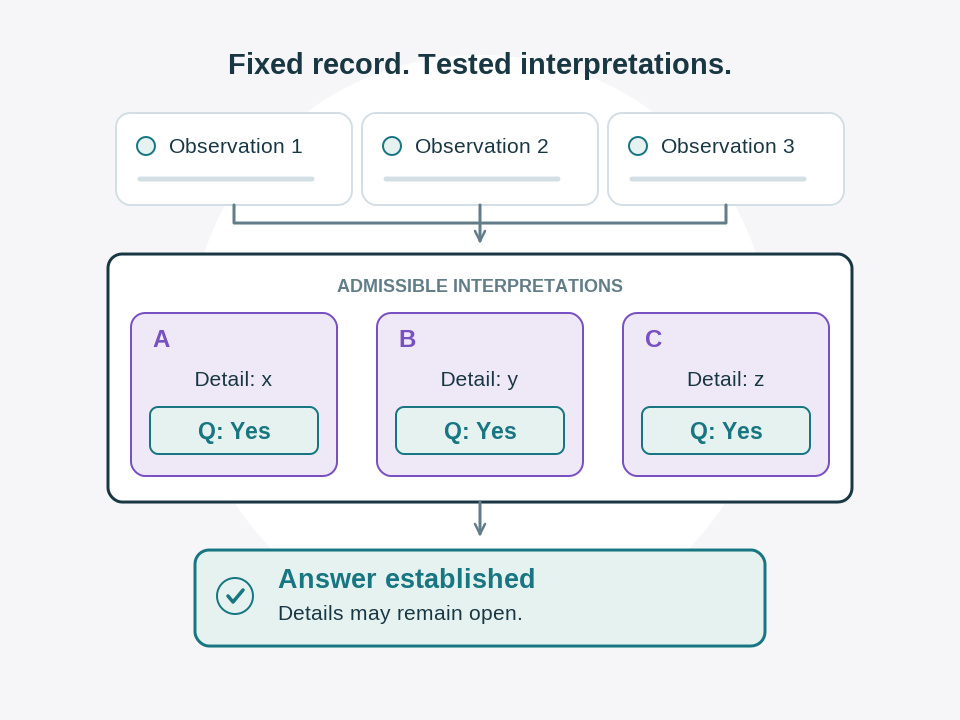
This assessment pattern asks what follows from a fixed record under declared rules and assumptions. Its candidates represent possible interpretations of that record. The interpretation is something to examine, rather than an operating option Leah is free to choose.
Start with the claim that matters
Evidence is useful in relation to a question. “Something is wrong” may be enough to stop a handoff, but too vague to specify a correction. “The printed code needs replacing and the destination needs correcting” is more demanding. It requires distinguishing the relevant fault combinations, while leaving unrelated details open.
Begin with the observations, their scope and the rules linking a possible condition to an observable result. Construct the complete interpretations the model allows. Reject those that conflict with the admitted record. Then ask the same question in every interpretation that remains.
An answer is established when at least one admissible interpretation exists and a completed counterexample check shows that no admissible interpretation changes it. This is stronger than finding one explanation that agrees with the desired answer. It is also more precise than demanding a unique explanation of everything.
| Part | Meaning |
|---|---|
| Fixed for this calculation | Supplied observations, their scope, the published interpretation rules and declared assumptions. |
| What varies | The possible explanations or assignments permitted by those rules. |
| A complete candidate | One interpretation supplying the modeled explanatory choices and their consequences. |
| Admissibility | The candidate satisfies the interpretation and consistency conditions. |
| Required judgment | At least one admissible interpretation exists, and no admissible interpretation changes the answer to the declared question. |
A reader should be able to name the question, separate the supplied observations from the inferred answer, and explain whether another admissible interpretation could change that answer. A list of successful checks is insufficient if their relationship to the claim remains hidden. When the answer is unresolved, the report should show a relevant disagreement or explain the limit of the evaluation.
An unreadable code can conceal another fault
The gifting example separates three possible faults: an unreadable printed code, a wrong destination and a restricted checkout. Its published model includes their joint combinations. It also specifies what the available checks would report in each combination. These are fictional teaching assumptions, not a universal account of every failed scan.
An unreadable printed code establishes a printing problem under this model. It does not reveal the destination concealed in that code. Both “printing problem only” and “printing problem plus wrong destination” can agree with the failed scan. The preferred correction cannot settle that ambiguity.
| Admitted record | What the modeled interpretations establish |
|---|---|
| The printed code is unreadable | A print fault is established. The destination and checkout questions remain open. |
| The source artwork also shows the wrong target | A destination fault is established as well. Checkout still needs its own basis. |
| The intended account completes the scoped checkout check | Under the published predictions, the supported correction is to replace the insert and correct the destination; a checkout repair is not established. |
Scope is part of the meaning of each observation. The artwork revision, batch, test device and intended account matter. A successful checkout for another account cannot silently answer this account’s question. A report for an earlier revision retains that earlier scope; changing a label would manufacture evidence.
Read the sequence above as a change in the admitted record. Adding the scoped artwork check can establish a destination fault that the failed scan alone leaves open. It does not make the scan a more complete diagnosis after the fact. A different correction budget or preferred supplier would change the response comparison, while leaving this evidence question unanswered until its own basis changes.
Follow Leah’s gift-kit correction case to see these findings feed a complete operating comparison. The evidence assessment establishes the correction need. The planning assessment separately checks which package can complete that work before handoff.
A record can also support a narrower operating requirement. In the shipment reservation desk, a confirmation covering the current order revision can support the corresponding planning check; an old-revision confirmation cannot. Inspecting that record’s scope is essential, but it is not by itself the full evidence-interpretation assessment described here. Reusing a display or the word “evidence” does not make the two judgments equivalent.
The findings create reusable decision points
The recurring structure includes what to consider after each finding. A business workflow specializes those response points with particular records, owners and available actions. It does not turn every open question into a requirement to investigate.
| Decision point | Reusable consequence | Gift-kit specialization |
|---|---|---|
| Is the supplied record admissible for this question? | Expose missing, invalid or out-of-scope information before relying on it. | Obtain a check for the actual batch, revision and intended account. |
| Has a completed check established that no interpretation fits? | Report inconsistency under the declared model; examine the record and assumptions. | Check conflicting reports, revision mismatches or an incomplete fault model. |
| Do admissible interpretations change the required answer? | Keep that answer open; identify what distinction matters to the response. | An unreadable code leaves the destination unresolved. |
| Is the required answer established? | Pass that scoped conclusion to the next assessment or responsible person. | Compare packages covering every established correction. |
| Would resolving the remaining ambiguity change the available response? | Consider a separate investigation-value question. | Assess whether another check is worth its cost and delay. |
Calculation limits require their own reading. An interrupted search that has found no admissible interpretation has not proved inconsistency. Conversely, finding two admissible interpretations with different answers demonstrates ambiguity even if other interpretations remain unexplored. An established Boolean answer can be false; “false” is an answer, not an execution failure.
The same structure can establish a coarser answer
Consider a separate finite teaching example: one of nine marbles is heavier, and the weighing reports allow a declared bound on recording errors. Three heavy-marble identities remain compatible with the record. All three are in the red bag. The bag is established while the exact marble remains unresolved.
The gift-kit and marble domains use different entities and rules. They share the same reasoning question: do all admissible interpretations agree on the answer we need? This is how the pattern transfers. Matching the words “test” or “evidence” is insufficient; the candidate meaning and conclusion contract must also match.
Carry the conclusion with its limits
Logical compatibility supplies no probabilities. Three remaining explanations need not be equally likely, and counting them does not by itself justify entropy or an expected-value calculation. How Much Uncertainty Is Left? explains why measuring uncertainty needs a stated basis. The evidence assessment also does not authenticate observations, guarantee a minimal explanation of every conflict or authorize corrective work.
Use this pattern when the meaningful alternatives can be represented finitely and the interpretation rules are explicit enough to assess. When the model omits a real failure mode, unanimity within that model cannot establish a broader real-world claim. A conclusion needs its source basis, scope, assumptions and evaluation coverage alongside its answer.
From Arrangements to Assessments explains the shared foundation. Can We Complete the Commitment? develops the next judgment in Leah’s story: whether a complete correction plan meets the obligations. What Is a Question Worth? addresses the separate choice to obtain more information.
Use What Must a Decision Report Establish? as a reading guide: trace the answer to its basis, identify the unresolved question and state what the finding supports next. Here the test is whether the correction need follows across the admissible interpretations, before anyone ranks operating responses.
Leah can now separate a justified correction need from a convenient explanation. That gives production and finance a common basis for comparing responses, while leaving the work, fresh verification and actual handoff to the operating process.
The Patterns catalog names this Evidence Assessment and places it within supporting reasoning. Use the recognition guide to compare its question and candidate meaning with the other assessments before mapping a new domain to it.