
How much would we learn by obtaining one more record, running a check, or waiting for an observation? To answer numerically, we first need to specify what remains unknown and when the information could affect a decision.
Consider a fictional supplier preparing a retail launch. Maya coordinates its shipment recommendation within a $5,000 expense limit. Direct costs $4,000 and Consolidated costs $5,000. The cost-first review prefers Direct while it meets the requirements and remains bookable; after Direct’s 11 a.m. cutoff, current support for Consolidated can make the premium necessary. See the related shipment exception for a different change: a current scoped confirmation restores support for Consolidated after an order revision.
The calculation below is a new teaching extension. Its probabilities and observation accuracy are stipulated assumptions, not measured shipment data or outputs from the published application. We use the following statement to keep choices, evidence, findings, and human decisions separate.
The slot names are explanatory notation for this argument. SDK schemas and workflow definitions specify actual records and steps. Human acceptance means agreement to an operating commitment.
This plan includes
plan_contents.
We have checked it under these conditions:assessed_conditions.
The result establishesestablished_finding.
We favorpreferred_optionsbecausepreference_basis.
Acceptance ofnext_actionisacceptance_status, withdecision_ownerresponsible.
If we observereassessment_trigger, we willcontingency_responsebeforeresponse_deadline.

Local production capture · shipment workflow 2.1.0. Capture and calculation record.
What exactly is unknown?
An uncertainty estimate needs a fixed question, operating interval, evidence basis, and set of possible conditions. Let denote the information already available. We describe the uncertain shipment situation by :
| Variable | Named field | Values in the teaching model |
|---|---|---|
| O | order_change | 0: no additional order revision before a specified release review; 1: an additional revision. |
| L | loading_window_status | 0: loading window usable at the planned loading time; 1: lost. |
| T | transit_duration | 0: quoted duration; 1: one day longer. |
These are conditions of the operation. Selecting a carrier is a decision about what to do; it is not an observation of O, L, or T. A loading slot means a reserved time window. The named information fields identify the quantities whose values or distributions we need to represent.
The chosen scenario set is . It admits eight combinations. That is a modeling choice: other delays, interruptions, and order changes outside the stated interval are not silently included. The assessed_conditions must retain that boundary as well as the supporting records.
What does a number in bits mean?
For a specified probability distribution over those states, remaining uncertainty can be measured by conditional Shannon entropy:1
Base-two logarithms express the result in bits. If all eight combinations have probability , then
In this special case, learning the answers to three balanced yes-or-no questions identifies the state. Three bits is also the maximum for an eight-state model:
The maximum is not an empirical estimate merely because eight branches were drawn. It becomes the actual entropy of this teaching model after the equal probabilities are stipulated. A real estimate needs a justified distribution. Entropy here concerns information uncertainty, rather than thermodynamic disorder, loss magnitude, or the quality of the plan.
Why can we not add a bit for every slot?
First suppose O, L, and T are conditionally independent given e and each is equally likely to be 0 or 1. Then
Different probabilities change the result even when all eight combinations remain possible. As a separate illustrative assumption, let the independent probabilities of an order change, lost window, and longer transit be 0.1, 0.2, and 0.3. Using the binary entropy function
we obtain
| Condition | Probability of value 1 | Marginal entropy |
|---|---|---|
| Order change | 0.1 | 0.4690 bits |
| Loading window lost | 0.2 | 0.7219 bits |
| One-day longer transit | 0.3 | 0.8813 bits |
| Joint entropy under independence | 2.0722 bits | |
Independence must be justified, not inferred from separate field names. Without it, the chain rule gives
For example, if deterministically and O, T are independent fair binary variables, the joint entropy is two bits. Adding three marginal one-bit entropies would count the same uncertainty twice.
The other slots in the decision statement also have different jobs. plan_contents records a selected arrangement. established_finding records an assessment claim. acceptance_status records a human decision. Unknown values in any of these can be studied, but the same probability model does not automatically apply to all of them. Settling a choice is different from learning a fact about the world.
How much can an observation teach us?
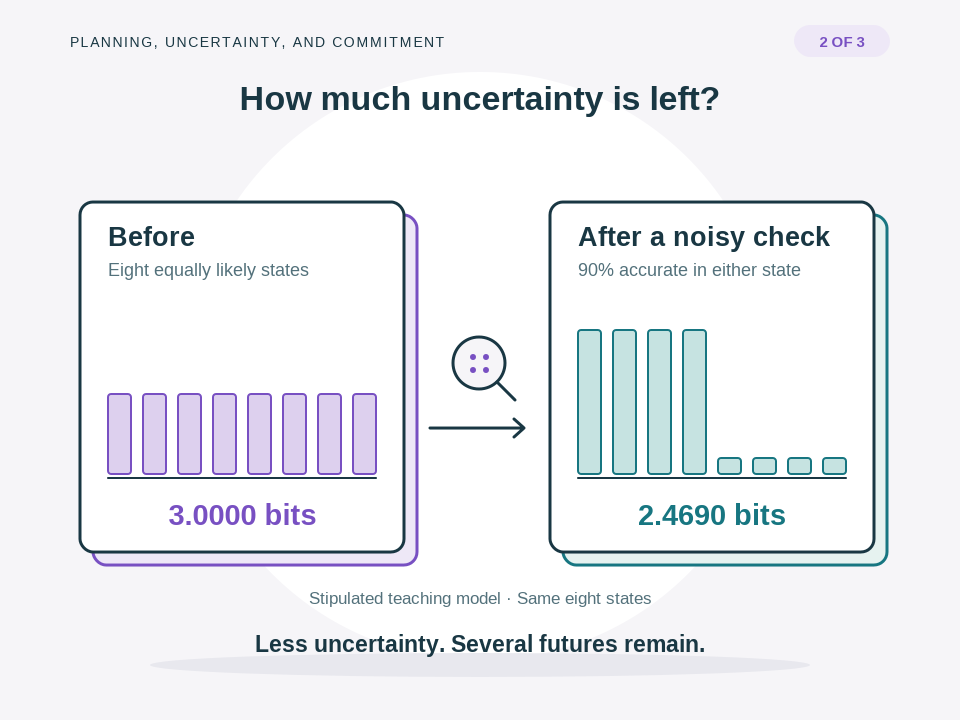
Return to the equal-probability, independent model with three bits of initial uncertainty. A perfect observation of O leaves four equally likely combinations of L and T, so the residual entropy is two bits. Observing both O and L perfectly leaves one bit about T.
“Perfect observation” is an ideal information assumption, not a claim that future events can be known in advance. For O, it could mean observing the authoritative order state at the specified release review before a later commitment. Transit information obtained only after arrival cannot inform an earlier booking decision. The time of each decision and observation must be part of the model.
Let Y be an observation available at the relevant decision stage. Before seeing its result, expected information gain is
The subtraction uses the average posterior uncertainty over possible results. Within a fixed valid probability model this expected gain is nonnegative. An individual surprising result can nevertheless leave a more uncertain posterior than the prior. Discovering a missing variable also changes the model rather than merely conditioning the old one.
What if the check can be wrong?
Suppose Y reports O correctly with probability 0.9 in either state, with a symmetrical error probability of 0.1. Its errors are independent of L, T given O, and the fair prior still applies. Bayes’ rule gives
The other two independent conditions remain unresolved. Consequently,
The check’s 90 percent accuracy does not mean that it removes 90 percent of the state uncertainty, or that a selected shipment succeeds with 90 percent probability. Those would be different claims requiring an outcome model.
| Information available | Residual state entropy | Gain |
|---|---|---|
| No new observation | 3.0000 | 0.0000 |
| Perfect observation of one condition | 2.0000 | 1.0000 |
| Perfect observations of two conditions | 1.0000 | 2.0000 |
| 90 percent accurate symmetric report of O | 2.4690 | 0.5310 |
All entries use the same state variables, horizon, and fair independent prior. Changing those assumptions requires recomputation. Coarsening the categories or discarding an awkward condition can lower a reported entropy without learning anything. Such a number is not a comparable improvement.
What should an actual estimate retain?
An estimate should identify the variable meanings and time points, possible values, available evidence, probability sources, dependencies, and excluded conditions. Observation models need their accuracy and availability time. A statement such as “three bits remain” should travel with that information.
If data do not justify probabilities, retain the possible scenarios, constraints, and support for their inclusion. Report what has been examined and where a plan is vulnerable. A count of successful unweighted scenarios is not automatically a success probability. Robust decision making supplies methods for examining strategies across plausible futures without requiring one trusted forecast.3
The report should also distinguish uncertainty about the full state from uncertainty relevant to the required answer. Several possible states may all support the same next action. Learning which of those states holds could remove entropy without improving the decision. Information has decision value through the choices it enables.2
Put the calculation beside the decision record
For this teaching case, assessed_conditions would retain the three variables, their time points, the eight-state scope, and the stipulated prior. The established_finding could report the calculated expected gain of 0.5310 bits for the specified noisy observation. It should not report that an operating plan or an approval has thereby been established.
Decision Lab’s linked shipment example evaluates arrangements and preserves their supporting report. The calculations here are a separate illustrative probability layer, not a claim that the current application produces calibrated entropy estimates. A practical extension would need reviewed variable meanings, probabilities, observation models, and an explicit connection to the operating decision.
Before obtaining an observation, finish this sentence: “We expect to learn about assessed_conditions from this check, by this time, with this reliability. If its result differs, which action could change?” The last question leads from information gain to the value of the plan.
Companion articles: Why Plans Are Not Enough distinguishes completeness, feasibility, preference, and human acceptance. A Better Plan Can Leave Us Just as Uncertain compares information gain with changes in operating value, exposure, and admissibility.