
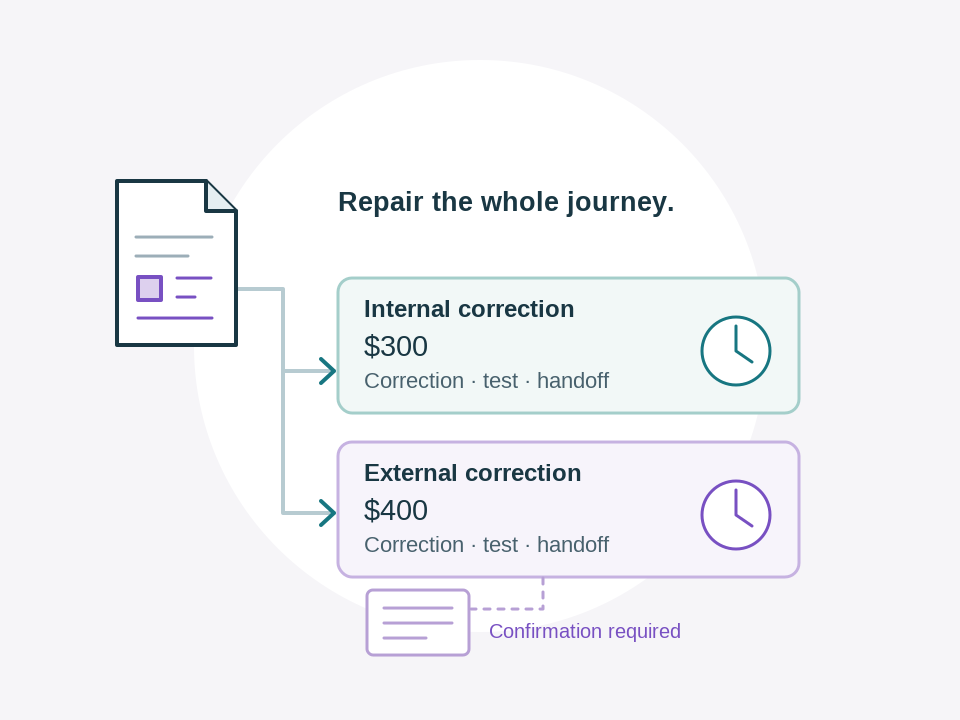
Leah now knows what the correction must address: the printed code and its destination both need fixing. Her next question is narrower: what makes the faster complete response worth another $100?
Production offers an in-house replacement and journey repair for $300. An external supplier quotes $400 for the same complete correction. Finance could reasonably ask Leah to use the cheaper package. Marketing could reasonably ask her to protect the promised handoff. Comparing price alone gives neither team an answer.
Compare the whole response.
Both quotes cover all 120 kits, but the correction is only part of the schedule. Leah must also allow for fresh rehearsal of the corrected recipient journey and the actual handoff. The planned complete sequence takes forty minutes in-house or twenty-five minutes externally. Each includes ten minutes of rehearsal; the authored minimum remains five.
An arrangement is a complete combination of the package, start, people, resources and supporting records under the current requirements. A low price on one task is insufficient if the complete sequence cannot meet the promise. The commitment assessment pattern supplies that reusable question: which declared complete arrangements can satisfy the obligations?
Leah uses a declared cost-first policy: meet the requirements, then prefer lower complete expense, then earlier handoff to break a tie. Both comparisons below retain the same $600 boundary, deadline, quotes, faults, resources, permissions and current supplier booking.
Change the remaining time, keep the policy.
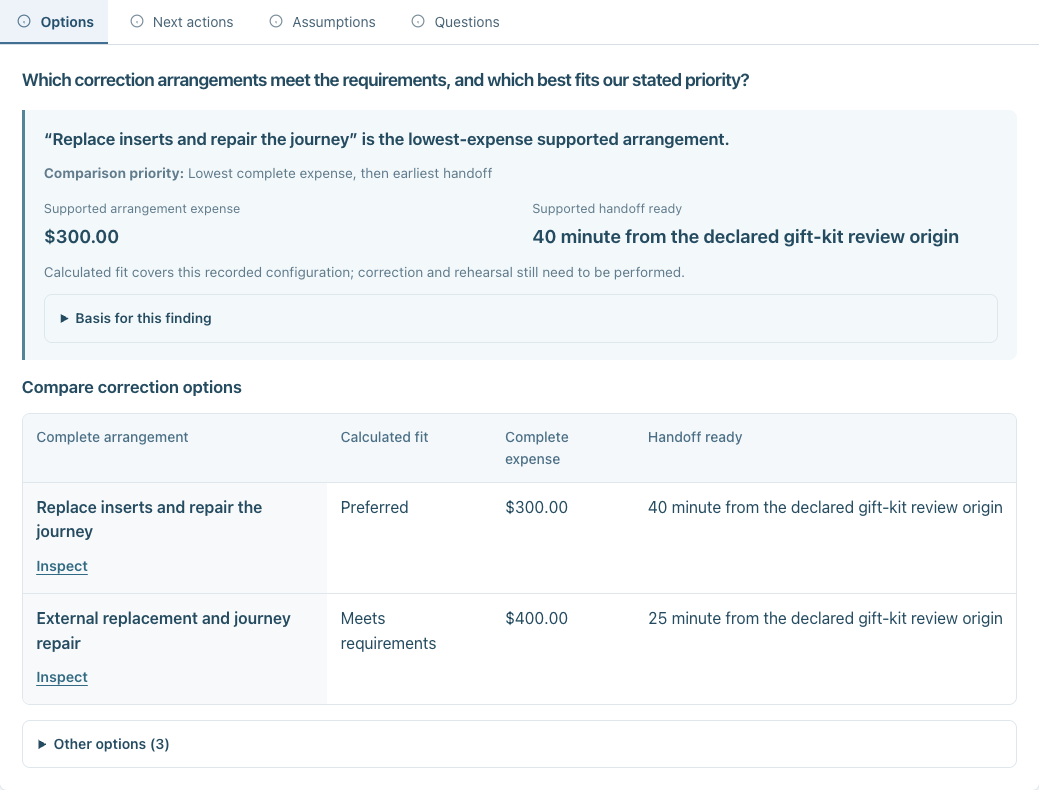
A full day remains.
The $300 in-house correction is preferred. Both complete corrections meet the requirements.
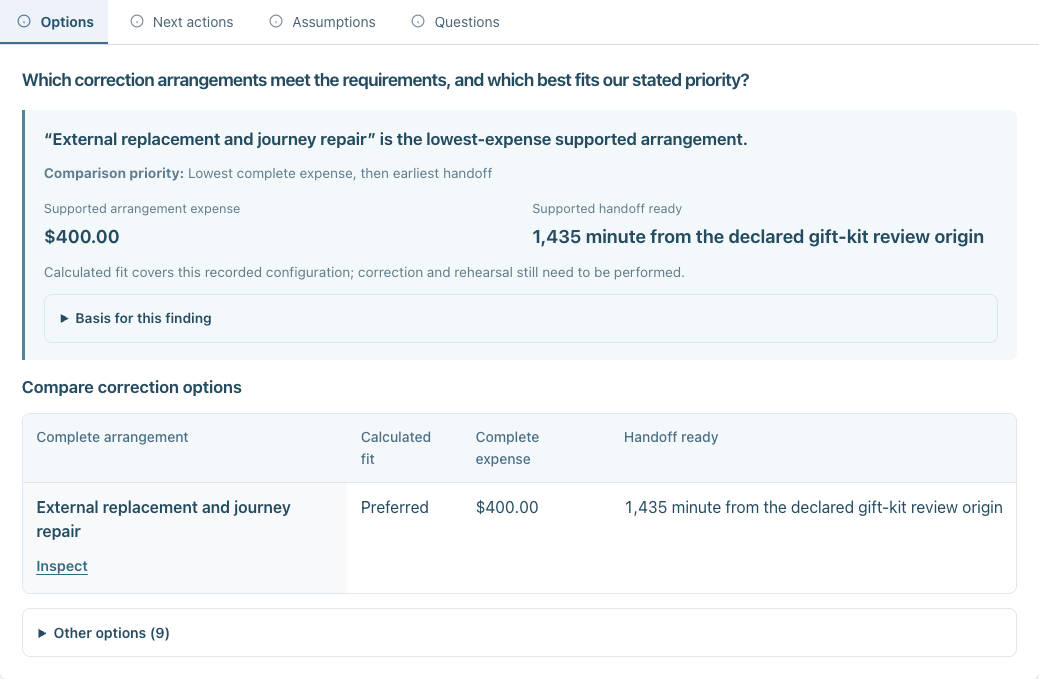
Thirty minutes remain.
The $400 external correction is preferred. In-house work is ten minutes late.
At the start of the day, both complete corrections fit. The in-house sequence takes forty minutes; the external sequence takes twenty-five. Finishing fifteen minutes earlier brings no modeled benefit that justifies another $100. Leah can put forward the $300 in-house correction.
Now consider a later review of that same campaign. Thirty minutes remain in the original one-day window. In-house work would finish ten minutes late. External work would finish with five minutes to spare.
The policy still prefers lower expense among arrangements that meet every requirement. Internal work has ceased to be an eligible alternative, so the same policy now supports the $400 external correction. The premium protects the original deadline; the calculation does not award extra points simply for being faster.
The quote is usable only with a booking for this work.
In the urgent thirty-minute case, the external package protects the deadline only if its supplier booking covers the current insert revision. Keep the order, price, quantity, time and correction fixed; inspect the scope named by the received record.
| Received booking covers | Urgent finding |
|---|---|
| Current insert-3 | The $400 external complete correction fits. |
| Earlier insert-2 | No supplied complete correction passes: external support is out of scope and in-house work is late. |
Inspect the distinct booking-scope finding
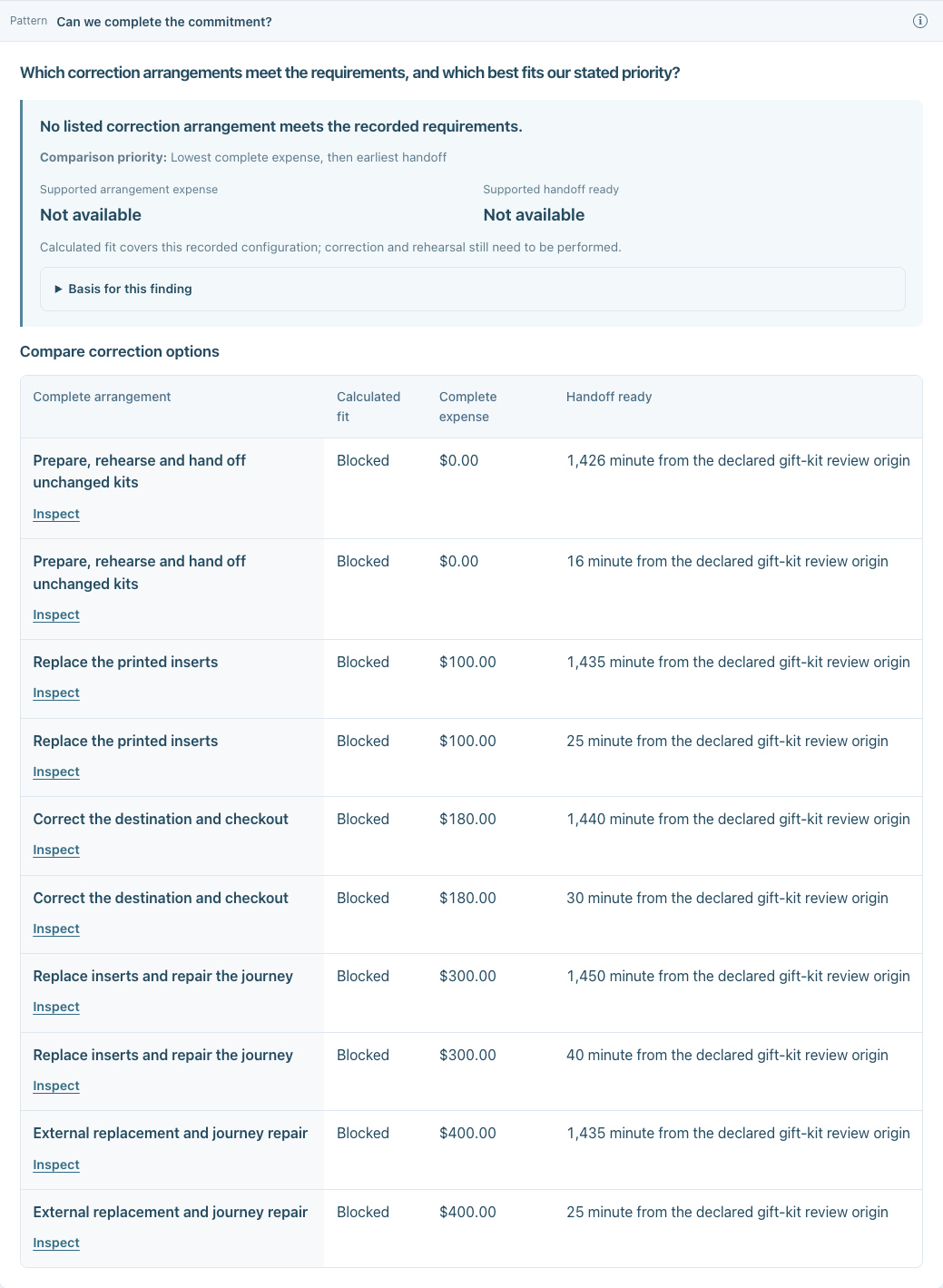
This is a different finding from the time comparison: it tests the supporting record, rather than the sequence duration. A cheaper or faster quote cannot establish supplier commitment for the actual revision. Leah must obtain a genuine current confirmation, find another complete response or escalate; editing the old record to make it fit would remove the point of the check.
Leah can explain both the premium and its condition.
With a day available, she can defend saving $100. With thirty minutes left and a current booking, she can defend the $400 external response. Without that confirmation, the useful answer is the specific unresolved condition. None of these findings establishes completed production.
Open the workflow or download the worked case from the collection guide. The developer follow-up carries a campaign from a CLI queue into a custom desk while retaining its operating evidence.