
Leah has several gift-kit campaigns to protect. Each promises 120 usable kits by its original one-day cutoff, with a $600 correction limit. Jordan needs to know which campaign requires a booking, a narrower diagnosis or a different commitment before the remaining time disappears.
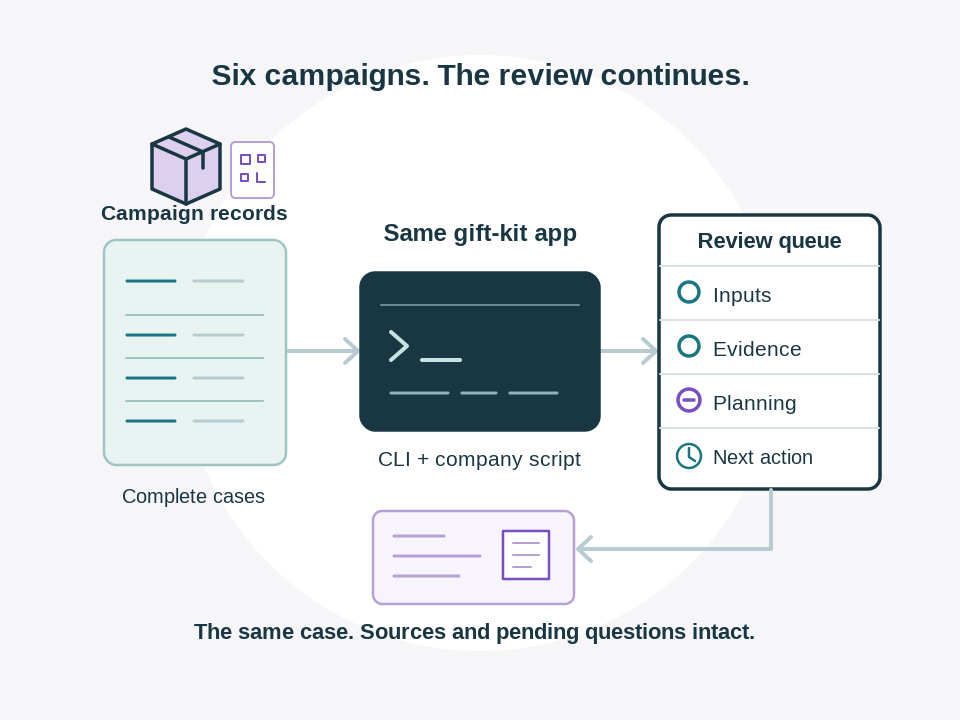
A workbook or custom script could produce that queue. The team would maintain its formulas, evidence interpretation, complete-package checks and case history. Here the developer uses the CLI to repeat the existing authored review, while company code supplies the input mappings and attention report.
Start with the current campaign snapshot.
The integration’s manifest connects the campaign to its responsible owner and source case:
      "id": "GIFT-321",
      "owner": "Jordan Reed",
      "case": "cases/urgent-window.json",
      "screeningCase": "screening/urgent-window.json"
    },
That case includes the original quantity and cutoff, diagnostic reports, current insert and checkout revisions, quotes, resources, permissions and booking records. Their source, scope and timing matter. A campaign ID and a new price cannot replace the underlying case.
The sample derives its conservative screen from this current business snapshot and checks that the mapping preserves the pinned planning rules. Company code owns that mapping; the CLI evaluates the supplied model. An old screening file with a matching ID would not be enough.
Calculate the review, then organize the intervention.
The selected excerpt invokes the public CLI through the sample’s command wrapper:
await command(['workflow', 'solve', '--run', currentPath, '--created-at', at, '--timeout-ms', '30000']);command supplies the invocation and error handling; workflow solve calculates the connected evidence and planning assessments. A successful command does not imply that any correction passes. The integration retains unavailable or incomplete calculations separately from a completed finding that no listed package works.
| Campaign | Calculated finding | Jordan’s next action |
|---|---|---|
| GIFT-320 · time available | $300 in-house complete correction. | Review the supported proposal. |
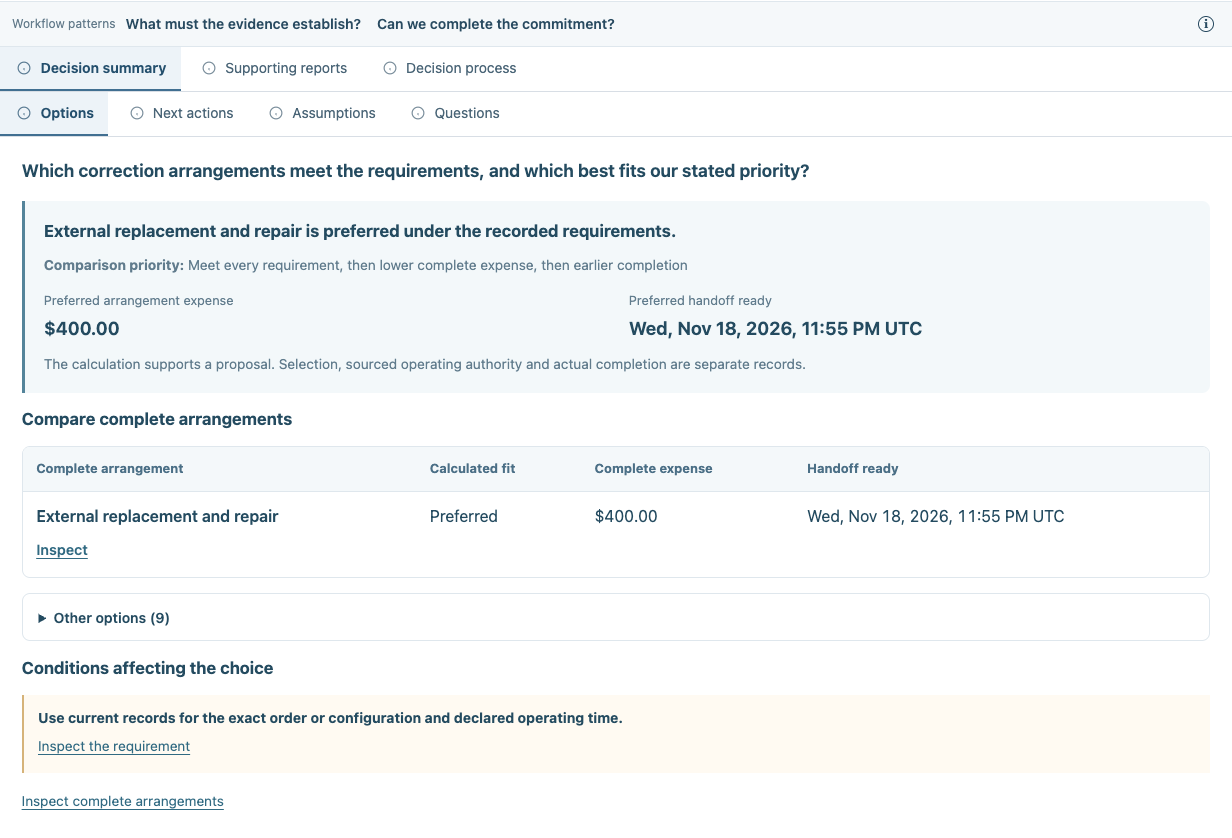
| GIFT-321 · thirty minutes remain | $400 external complete correction. | Review the urgent response and its booking. |
| GIFT-322 · booking missing | No supplied complete package fits. | Obtain the missing record or escalate. |
| GIFT-323 · booking covers old insert | No supplied complete package fits. | Obtain genuine current-scope confirmation. |
| GIFT-324 · narrower supported fault | $100 printed-insert replacement. | Review the diagnostic basis for the smaller correction. |
| GIFT-325 · start too late | No declared package protects the cutoff. | Escalate or explicitly reconsider the promise. |
The queue’s owners, presentation and next-action wording belong to the sample integration. The authored assessments supply the findings beneath them. Campaigns use independently allocated resources; passing them individually does not prove that they can share one production team simultaneously.
The queue retains the diagnostic basis as well as the proposed package. The diagnosis story explains how the supported faults determine what needs correcting.
Open the flagged campaign in a focused desk.
Jordan opens GIFT-321's native continuation with the same definition, pinned app, original promise, sources and current findings. The React client verifies compatibility before reopening it:
const run = lab.workflows.openRun(value);When a relevant premise changes, Jordan applies it through the SDK and recalculates the authored evidence-to-planning chain. The earlier result remains historical while dependent current findings are stale. Forms, storage and lifecycle belong to the custom client; the assessment logic remains in the SDK and authored app.
return lab.workflows.solve({ run: current, ...(execution ? { execution } : {}), createdAt: atTime(at) });The desk passes the workflow output and definition to the shared report host:
  return <WorkflowReportsView output={output} definition={definition} pending={dirty}
    blockedReason={blockedReason} readOnly />;
The CLI and SDK retain one case rather than copying a headline between systems. The Decision summary gives Leah the current proposal; supporting reports explain its requirements. Inspecting a report selects no work and creates no authority.
Jordan can act on the exception instead of rebuilding it.
The urgent campaign has a supported $400 complete correction, with its requirements and original cutoff intact. Jordan can examine its current booking and take the proposal to the people responsible for carrying it out. Changing the interface has not changed the rules or turned a calculated proposal into completed work.
The native export carries the applied case and its history to the next compatible client. Separate authorization and operating records remain available in the complete CLI-to-React implementation. The company still owns its sources, access control, durable storage and actual production.