
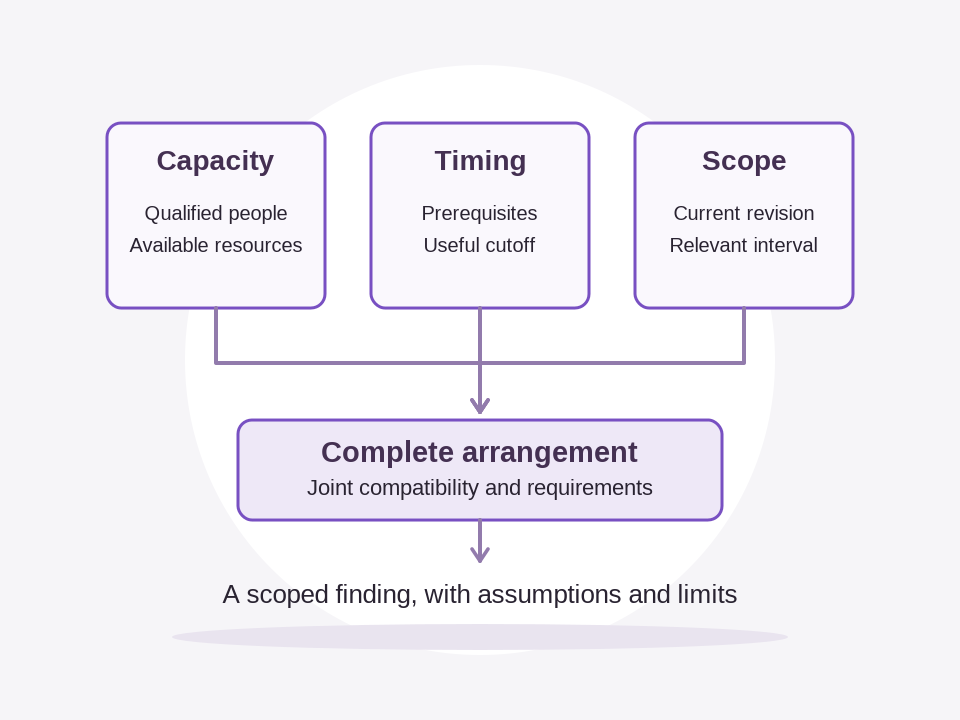
A complete decision often depends on smaller questions that recur across domains. Can the assigned person do this work? Does a confirmation cover the actual order? Is the cheaper response still available? Naming those approaches helps explain how a larger assessment is assembled.
These six entries are supporting reasoning idioms: recognizable approaches demonstrated in our cases. We are not claiming six independent public SDK components. Some are requirements or calculations within an authored app; others organize comparison and reassessment.
Complete Candidate Compatibility
Question: do the parts of this complete response satisfy the conditions together? Supply candidate bindings, their relationships and the relevant requirements. Check joint compatibility rather than approving each choice independently.
In the restaurant roster, replacing the absent cook must leave every remaining service covered. Moving someone to Saturday can create a Sunday gap. The finding concerns complete supplied repairs; it does not establish that every possible roster has been generated.
Qualified Capacity
Question: can the assigned resource perform the required amount of work within the applicable conditions? Retain workload, availability, qualifications, other commitments and the division of work.
In the extra-tester comparison, four hours transfer as a fixed independent-regression package. Qualification for the required build and environment matters. Headcount or free hours alone cannot establish usable capacity, and arbitrary work cannot be split merely to make the arithmetic fit.
Dependent Timing
Question: do the required intervals and dependencies fit before the relevant cutoff? Supply durations, calendars, prerequisites, start and end positions, and distinct deadlines. Preserve the meaning of booking, arrival, review and completion times.
In Leah's correction comparison, the $300 in-house package fits the one-day window but cannot finish when only thirty minutes remain. The $400 external package can still fit, provided its confirmation covers the actual work interval and current insert. A possible schedule establishes neither a reservation nor completed work.
Scoped Support
Question: does this record support the particular claim being assessed? Match identity, revision, resource, location and validity interval as required. Preserve the source record's actual scope.
In the current-booking case, a confirmation for an earlier insert revision cannot support the current insert, even when the booking interval remains unchanged. In shipping, revision-1 permission cannot silently become revision-2 permission. Matching fields do not authenticate a record, and this check is not automatically a formal Evidence Assessment.
Explicit Preference
Question: among arrangements that pass, which does the declared policy prefer? Supply eligible candidates, comparable criteria, priority order and tie handling. Keep those criteria separate from mandatory conditions.
In Elena's roster choice, cost and stability can favor different feasible repairs. Neither preference can make an unavailable cook available. In release recovery the app does not rank; Nina instead explains her management preference. Read Which Feasible Option Should We Prefer? for the distinction.
Changed-Basis Reassessment
Question: what needs reassessment when a supporting fact changes? Retain the earlier basis, current records, app identity and dependencies. Distinguish a changed record, a changed calculated finding and the next operating action.
In the shipment exception queue, revised orders can invalidate confirmations or permissions. A malformed input receives its own diagnostic. Earlier findings remain history, while current support requires a fresh assessment. Comparing runs does not authenticate the new records or prove one changed field caused every difference.
Combine questions while preserving their meanings.
A commitment assessment may use several idioms together. A finding can support another question only when its meaning, scope and outstanding conditions fit that question. Recognize the Decision Structure starts with the larger judgment; the pattern library shows which named approaches each example demonstrates.