
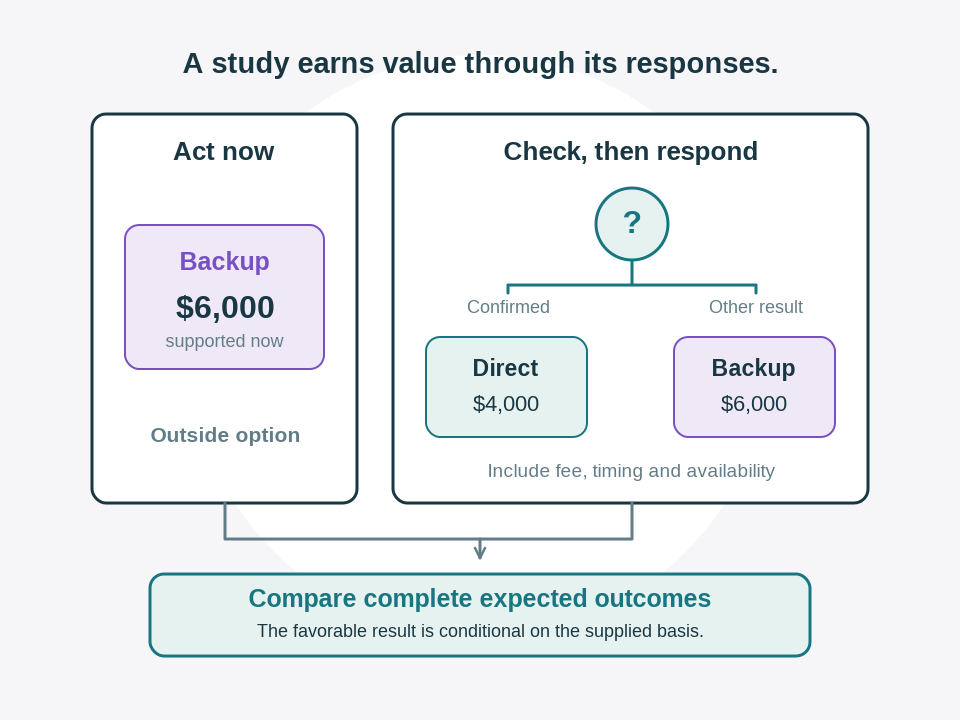
Maya has a supported $6,000 Backup shipment and a cheaper Direct option that needs current registration confirmation. A check costs $200. Its result could enable Direct, but it could also be inconclusive or arrive too late. Before the noon reservation cutoff, she needs to decide whether buying that check improves her proposal.
Her analyst has a Python model estimating registration. A probability answers part of the question. It does not say which shipment responses meet the requirements, how much the check costs, whether its report will be usable or whether Maya can still act when it arrives.
This assessment pattern compares a complete investigation-and-response alternative with the best available outside option. Its candidate includes the study and what to do after each observable report. The question is whether that alternative improves the modeled outcome enough to justify obtaining and using the information.
Information is useful through a possible response
Suppose a check could resolve an uncertainty perfectly but every available response would remain the same. It might improve understanding while adding no value to this particular decision. Conversely, an imperfect check can be useful if its reports distinguish situations that call for different feasible actions.
The comparison begins with what the team can do without buying the study. That outside option must be the best supported available response under the same objective and scope. Comparing a study with an unnecessarily expensive or unavailable alternative would inflate its apparent advantage.
Next specify the possible underlying states, actions, study reports, probabilities and consequences. A response must depend on the report the team can actually observe. It cannot depend directly on a hidden state that the study never reveals. Inconclusive and unavailable results need their own explicit treatment.
| Part | Meaning |
|---|---|
| Fixed for this calculation | The published state, action and study meanings; objective, scope and units; supplied numerical premises and operating conditions. |
| What varies | The declared study choice and complete responses to its possible observable reports. |
| A complete candidate | An investigation with an available response for each relevant report branch. |
| Outside option | The best supported action available without the proposed study. |
| Required judgment | Compare complete modeled net outcomes, accounting for fee, timing, cash and response availability. |
A useful report must let the reader identify what can be done now, what each observable study result permits next, and what fee and delay are included. It must also distinguish an unsupported numerical premise from a study that has been assessed and found unattractive. Those findings call for different responses: improve the basis in the first case; consider the supported outside option in the second.
Different premises require different kinds of support
An evidence assessment can establish which interpretations remain compatible with records. It does not assign their probabilities. A commitment assessment can establish which complete responses satisfy modeled obligations. It does not establish how often uncertain states will occur. Learning value needs those meanings plus an explicit numerical basis.
In the shipment integration, Python supplies a model’s proposed registration probability, checked against synthetic records, and historical estimates for report outcomes. Separate planning assessments supply the supported reserve-now and after-check responses. The adapter preserves the source references when it binds these inputs into the learning assessment.
The worked model proposes 24.96% registration. The chance of a usable positive report is lower, about 21.35%, because a check can be inconclusive. Those numbers are supplied assumptions from a synthetic teaching pipeline. Neither number substitutes for the authoritative confirmation required before Direct can be used.
A timely check can improve the proposal
This fictional learning case has its own supported planning basis: reserving Backup now costs $6,000. A timely $200 check supports a response using Direct if usable confirmation arrives, and Backup otherwise. Its expected complete expense is $5,772.96, including the check fee once. The modeled improvement is $227.04.
| Changed context | Modeled comparison | Supported proposal |
|---|---|---|
| A timely $200 check | Expected complete expense $5,772.96 versus Backup now at $6,000. | Put forward the check-and-response alternative under the stated numerical basis. |
| Only the fee rises to $2,500 | Expected complete expense rises to $8,072.96; Backup remains $6,000. | Reserve Backup now instead of buying that check. |
| The $200 check and response are ready at 3 p.m. | The result is after the noon action cutoff. | Use the supported reserve-now option; the information cannot restore an expired response. |
These figures are expected costs, not promised realized payments. In the timely case, usable positive confirmation can support Direct at $4,200 including the check. Otherwise Backup costs $6,200 including the check. The favorable expected comparison preserves both outcomes rather than treating the average as an actual shipment quote.
The comparisons isolate two different reasons to decline the check. In the fee comparison, the estimate and 10:30 a.m. response-ready time remain fixed; only the fee rises. In the timing comparison, the fee stays $200 and only the check duration changes, moving the complete response from 10:30 a.m. to 3 p.m. A reader should be able to tell an unfavorable expected comparison from an action that would arrive too late. A precise average cannot reopen the reservation window.
Follow the Python shipment integration for its side-by-side reports, SDK calls and numerical source basis. It shows how a model can remain in Python while Decision Lab evaluates the complete response and information-value questions.
The reusable judgment includes response points
The pattern contributes more than a calculation of “information gain.” It identifies recurring reasons to investigate, act now, obtain a better numerical basis or decline an unsupported comparison. A workflow specializes these points with the organization’s actual owners and procedures.
| Decision point | Reusable consequence | Shipment specialization |
|---|---|---|
| Are the numerical premises and available responses sufficiently supported? | Expose missing basis or unsupported applicability before claiming value. | Correct the estimate or response records; retain independent planning findings. |
| Could an observable report change the supported action? | Compare the response branches rather than treating information itself as an outcome. | Use Direct after valid positive confirmation and retain Backup otherwise. |
| Can the result and response occur before their deadlines? | Mark unavailable responses explicitly; withhold a study alternative when a possible report has no complete available response. | A 3 p.m. result cannot support a noon reservation. |
| Does complete net value improve on the best outside option? | Present the conditional advantage, disadvantage or genuine tie. | Compare the timely check with reserving Backup now. |
| Does the preferred alternative change under plausible declared premises? | Show the sensitivity and the assumptions that matter. | Expose the point at which a larger fee removes the check’s advantage. |
Cost and delay can change what remains feasible. When they do, the assessment compares complete study-and-response alternatives. Calling the whole difference “pure information value” would hide those operating effects. That narrower term is appropriate only when the feasible action set remains unchanged.
The same structure applies to another investigation
In a finite marble teaching example, three heavy identities remain in the red bag. Explicit probabilities and payoffs make a further comparison useful when the decision is which exact marble to select. The study can change the action and its expected outcome.
If the payoff instead depends only on choosing the containing bag, learning the exact identity can add no decision value: the red-bag choice is already established. The investigation’s detail is the same; the decision and consequences differ. This is the distinction between reducing uncertainty and improving a particular choice.
A Better Plan Can Leave Us Just as Uncertain develops the distinction between operating value and remaining uncertainty. Entropy can describe uncertainty for a specified probability distribution. It does not supply the shipment requirements, action payoffs or study timing needed for this comparison.
The promotion expense-recovery threshold illustrates the boundary. Calculating how many genuinely additional guests would cover a deployment’s cost does not supply a response forecast or the probabilities needed to value an investigation. A study in that domain would need its own observable reports, available responses and justified numerical premises. Which Feasible Option Should We Prefer? explains why a financial threshold also does not establish a profit ranking among feasible deployments.
Keep the recommendation conditional
The current learning pattern evaluates finite states and actions with one optional study followed by a response. Its installed objective is risk-neutral expected money. It supports declared sensitivity cases; it does not infer probabilities from compatible explanations, search every experiment or build an unrestricted sequential learning program.
A preferred study establishes neither the underlying state nor a guaranteed payoff. It also grants no authority to purchase the check or book freight. If the model or historical population is inapplicable, a precise expected value can still be an unjustified premise.
What Must the Evidence Establish? explains the interpretation question. Can We Complete the Commitment? explains how to establish supported operating responses. This third assessment connects information to those responses and their consequences while retaining their separate meanings.
The reading test in What Must a Decision Report Establish? applies here with a specific meaning: can the reader explain why the investigation changes the supported response, which premises justify its expected advantage, and when the outside option is preferable? The report supports that conditional proposal; the actual study result still has to arrive and be used.
Maya’s analyst can now explain when the check is worth proposing and when it is not. The useful outcome is a decision with an inspectable basis: a supported response now, or a justified investigation with timely actions after its actual result.
The Patterns catalog names this Information-Value Assessment and places it within supporting reasoning. Use the recognition guide to compare its question and candidate meaning with the other assessments before mapping a new domain to it.