
Maya must protect a delivery promise before reservations close at noon. Direct costs $4,000 but depends on unresolved transportation registration. Backup costs $6,000 and meets the requirements in both admitted registration states. Finance needs to understand what justifies paying more.
A genuine current scoped confirmation establishes the registration required by Direct. With the shipment, quotes and cutoff fixed, the lower-cost response can now enter the complete comparison. A lower price or a different priority cannot supply a missing operating condition.
The commitment assessment asks which complete operating arrangements satisfy the declared obligations. A separate preference policy can distinguish among the passing arrangements. The conclusion supports an operating proposal; authorizing and fulfilling it remain further work.
Begin with the promise, not the cheapest fragment
A commitment links an outcome to conditions under which people propose to deliver it. The delivery date alone is insufficient. The shipment may need preparation time, available people, equipment, current registration, a scoped confirmation, enough spending authority and enough cash when payments fall due.
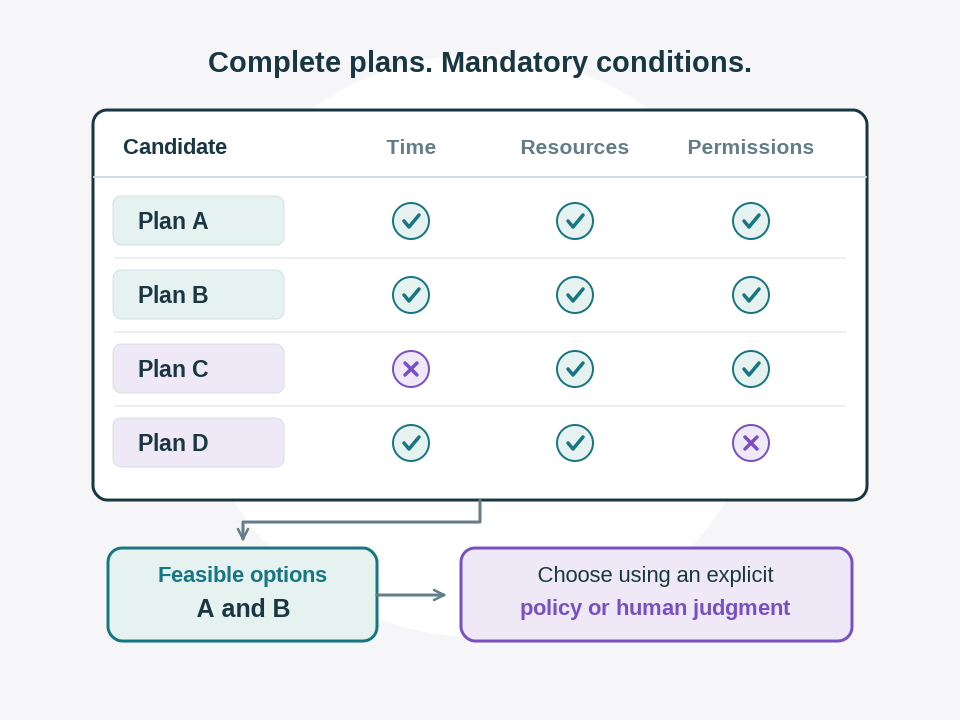
Each candidate must bind the relevant choices into one complete arrangement. A route, dispatch time and resource can each look acceptable in isolation yet fail together. Complete describes the candidate’s structure; feasible describes whether that candidate satisfies the mandatory requirements.
Define F as the set of declared candidates that satisfy those requirements. A fully checked passing candidate establishes that F is nonempty. Establishing that F is empty requires sufficient coverage or another sound proof. A stopped search that found nothing establishes neither.
| Part | Meaning |
|---|---|
| Fixed for this calculation | The published requirements, supplied commitment, records, resources, units and declared operating situations. |
| What varies | The modeled operating choices, combined into complete candidates. |
| A complete candidate | One selectable arrangement of work, timing, actors, resources and other required choices. |
| Feasibility judgment | The complete candidate meets every mandatory obligation under the explicitly admitted situations. |
| Preference judgment | A declared comparison policy establishes the highest-ranked passing candidate or tied candidates. |
Before looking at a result, ask what would make it usable. The reader needs the complete candidate, its decisive mandatory conditions and their input basis. A blocked option should reveal the failed condition. An unfinished comparison should retain any fully checked passing candidate while explaining which stronger conclusions remain unavailable. The absence of a displayed option is not a proof that none exists.
Map the shipment to the reusable structure
The Marketplace example keeps two possible registration states while the portal listing leaves the required fact unresolved. Direct costs $4,000 but fails in the unregistered state. Backup costs $6,000 and meets the requirements in both states. The quoted price is only one part of each complete shipment response.
The evidence assessment determines which registration states the supplied records admit. The commitment assessment then checks each complete response against every admitted state and its other operating requirements. An attractive quote does not resolve uncertainty about registration.
| Context | Supported conclusion | Why |
|---|---|---|
| Registration remains unresolved | Backup is supported at $6,000. | It meets the requirements in both admitted registration states. Direct does not. |
| A current scoped record establishes registration | Direct is supported at $4,000. | The new evidence establishes the registration required by Direct; the other requirements still apply. |
The new record changes the admitted factual basis; it does not change the shipment or waive any requirement. Calculated support remains distinct from spending authority, carrier reservation and completed delivery.
To read this comparison, hold the shipment, prices, resources, requirements and cutoff fixed. Change only the supplied registration evidence. The report should let Maya trace Direct’s newly supported response to a genuine current scoped confirmation. A preferred-option headline alone would hide what made that option usable.
See the side-by-side registration comparison for the working application. Follow the SDK reservation desk to see a genuine current confirmation change a blocked assessment, while the retained history preserves what the earlier record actually supported.
The judgment comes with reusable response points
Once the pattern’s question is explicit, the recurring branches become recognizable. The same findings can arise in shipments, workforce rosters or correction schedules. The business process supplies the concrete responses and the people entitled to make them.
| Decision point | Reusable consequence | Shipment specialization |
|---|---|---|
| Can this calculation establish the required judgment? | Separate missing or invalid inputs, stale results and unfinished evaluation; identify the appropriate next step. | Obtain current inventory or booking records, apply changed inputs or complete the calculation. |
| Has sufficient evaluation established that F is empty? | Report that no declared candidate satisfies the modeled requirements. | Consider another route, timing, resource or legitimately revised requirement. |
| Has a fully checked candidate established that F is nonempty? | Present supported options while retaining any limits on the remaining comparison. | Show complete feasible shipment arrangements. |
| Is there an explicit, applicable policy and sufficient comparison coverage? | Apply it, retaining ties; otherwise leave preference unresolved. | Use declared cost and delivery priorities rather than an implicit cheapest-first assumption. |
| Has a person selected a supported option? | Continue to the separately governed operating work. | Obtain authority and reservation, then establish dispatch and actual delivery. |
A completed assessment can establish that no candidate passes. An unfinished assessment can retain a fully checked witness without establishing the preferred option. Completion, feasibility and preference therefore need separate meanings. Genuine ties should remain visible; an arbitrary list order is no decision policy.
A blocked result does not establish which requirement ought to change. A spending limit, safety condition and customer promise have different owners and consequences. Showing failed checks is useful, but it is not a guarantee of a minimal conflict diagnosis or permission to relax a condition.
The same judgment applies to a restaurant roster
Elena faces a cook’s callout before Saturday dinner. Moving a qualified cook from Sunday fills Saturday’s gap but creates another. A complete repair must preserve every recorded service, role, availability interval, employee condition and payroll boundary.
The restaurant example supplies four complete repairs. With a relief cook available until closing, two pass. Shorten only that availability to 8 p.m. and one fails. The remaining candidate is feasible within the supplied set. A separate priority is needed if Elena wants to prefer fewer changes or lower payroll.
Follow the restaurant roster repair to see the same assessment structure without freight terminology. Its candidate is a complete remaining roster; Maya’s is a complete shipment arrangement. Both require checking joint compatibility before applying a defensible preference.
These are the same assessment questions with different meanings for the candidate and its conditions. The shipment cutoff and the cook’s availability are both mandatory compatibility conditions; neither is a score to trade against a low price. Which Feasible Option Should We Prefer? follows the restaurant case further by holding the operating facts fixed and changing only the declared comparison priority.
Preserve the supported scope
The current Commitment Planner evaluates finite, complete static arrangements. Their operating choices are fixed before the explicitly admitted situations. It can require one arrangement to satisfy obligations across those situations, but it does not infer that the listed situations cover every real uncertainty. General conditional policies remain outside its current public support.
The assessment does not reserve resources, authenticate records, issue spending authority or establish actual completion. Two independently passing shipments may still compete for the same truck. A portfolio claim requires a model that represents their joint demand.
From Arrangements to Assessments connects this judgment with the evidence and learning patterns. What Is a Question Worth? asks a further question when an unresolved fact matters: would obtaining information improve the available response enough to justify the investigation?
Read What Must a Decision Report Establish? for the broader reading guide. For this assessment, the practical test is concrete: can someone explain which complete options pass, why another is blocked, whether a preference has actually been established, and what operating work remains?
Maya’s useful outcome is a proposal she can explain: which complete option remains supported, why the context justifies its expense and what must happen next. The assessment makes that basis inspectable. The business process connects it to an authorized and fulfilled commitment.
The Patterns catalog names this Commitment Assessment and places it within supporting reasoning. Use the recognition guide to compare its question and candidate meaning with the other assessments before mapping a new domain to it.