
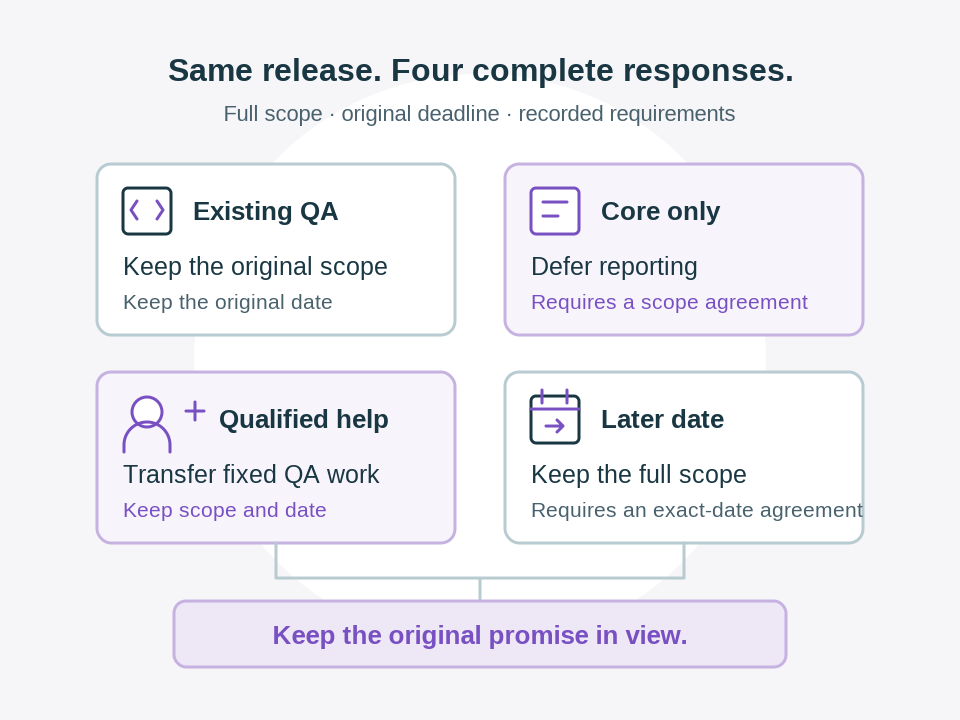
The deadline is fixed. The next promise needs support.

Nina has promised core functionality and reporting by Monday at 5 p.m. The remaining QA exceeds her existing qualified allocation. Additional help is useful only if the right work can transfer. Changing scope or date would mean negotiating a different promise.

Four complete responses to the same release promise: existing QA, reduced scope, additional qualified help or a later date.

Release recovery / Articles

Recover the promise. Or agree what changes.

The recovery story includes the qualification that makes additional help usable. The second story changes a separate fact: customer acceptance of reduced scope.

  1. Consider an explicit scope revision

    Can we ship without reporting—and who has to agree?

    A reduced release fits the original cutoff, but changes what the customer was promised. See how a recorded scope amendment changes the supported choices without rewriting the original commitment.

Open the release example.

The link opens Plan an at-risk release with fictional inputs and installs Software delivery when needed. Choose Calculate, then inspect a named arrangement in the Decision summary to see its supporting requirements.

Open the release example

Worked cases and references

Use My cases → Import workflow run to open a retained comparison. Choose Apply inputs and Recalculate after changing its inputs. Decision process maps the questions and available responses.

Bring remaining-work estimates from Jira

The sample repository provides a CSV adapter and complete walkthrough. It maps remaining QA hours into the authored core and reporting packages; this is separate sample code, not a built-in Jira connection.

The fictional export preserves a ticket marked Done with eight QA hours remaining. Nina needs the team to clarify both statements. Ticket status alone establishes neither completed testing nor customer acceptance.

The adapter retains its source snapshot and supplies workload totals. The team must separately establish qualified capacity, working intervals, spending authority, prerequisites and any accepted scope or date revision.

Inspect the fictional CSV, mapping profile and retained source manifest. Additional fixtures demonstrate an unknown estimate and an external prerequisite. The published model identifies the current reasoning app.