
Return to the full-availability situation from Elena’s coverage analysis: Rowan can work the whole Saturday shift, and two supplied repairs meet the restaurant’s recorded requirements. Neither leaves another service short.
The choice still has consequences. Rowan’s relief quote preserves the other published assignments. The cheaper alternative moves Theo to Saturday, moves Ben into Sunday cooking and adds Ava to Sunday serving. The roster is already published; employees have planned around it. Elena also has a labor expense boundary to respect.
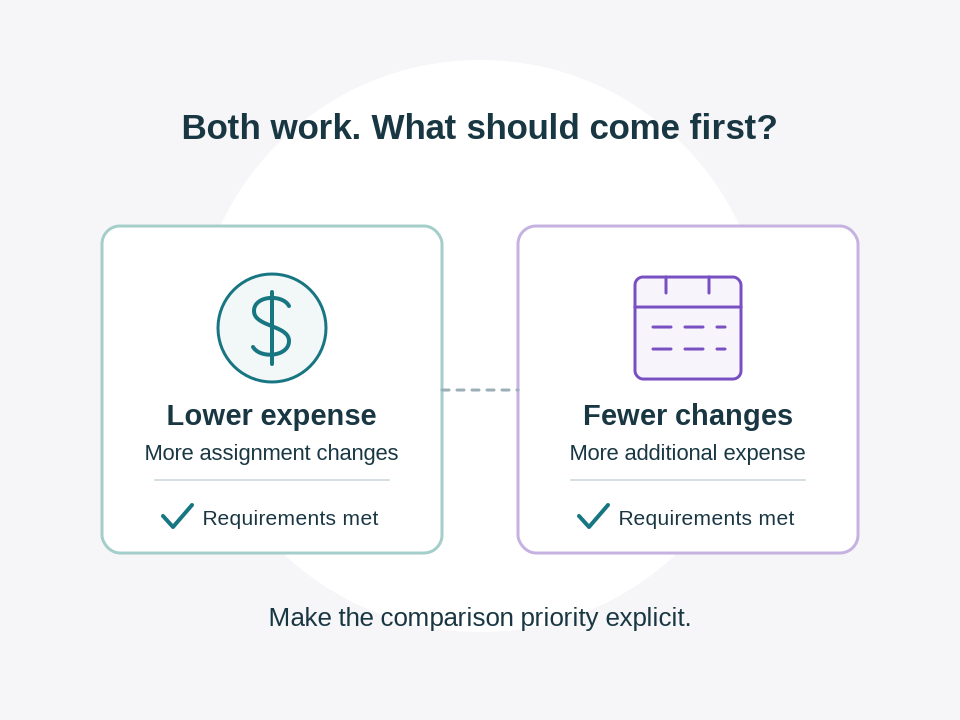
Calling the cheaper option “best” would hide a priority inside the recommendation. Calling the smaller change “fairer” would claim more than the calculation establishes. Elena needs to state what should come first for this decision.
This fictional continuation uses Repair a published restaurant roster 1.9.0 in the Restaurant operations collection. The comparison priority changes within the same workflow; the four supplied repairs, employee records and mandatory conditions stay fixed. Open the workflow and follow the shared setup instructions.
Keep the operating requirements fixed.
Elena’s next assessment question is which feasible complete repair comes first under the priority she declares? Each candidate still represents the entire remaining roster. The priority orders the repairs that meet the mandatory conditions; it cannot make a failed repair workable.
Every comparison requires the recorded qualifications, availability, role coverage, rest, hours and non-overlapping assignments. Each enforces the $856 remaining-payroll limit. Rowan is available from 6–10 p.m. The earlier failed repairs stay failed.
| Repair | Remaining payroll | Additional expense | Changed published positions |
|---|---|---|---|
| Bring in Rowan | $836 | $180 | 1 |
| Repair three assignments | $736 | $80 | 3 |
Additional expense compares each complete remaining roster with the $656 retained after Nora’s cancelled, unpaid shift is removed. Earlier-week payroll is outside that figure. A changed position is a published service-and-role slot assigned to a different person, including a vacancy. Replacing Nora counts once; it does not count separate notifications to Nora and her replacement.
State what should come first.
Elena compares two explicit priorities: preserve published assignments first, or minimize remaining payroll first. She can also leave the repairs unranked.
The stability-first priority minimizes changed published positions, then remaining payroll. The cost-first priority minimizes remaining payroll, then changed positions. These are ordered comparisons, with no invented exchange rate between a dollar and an employee’s disruption. If repairs tie on both declared criteria, the comparison retains the tie.
Applying either priority updates the preference without changing the employee facts or repeating the still-current feasibility calculation.
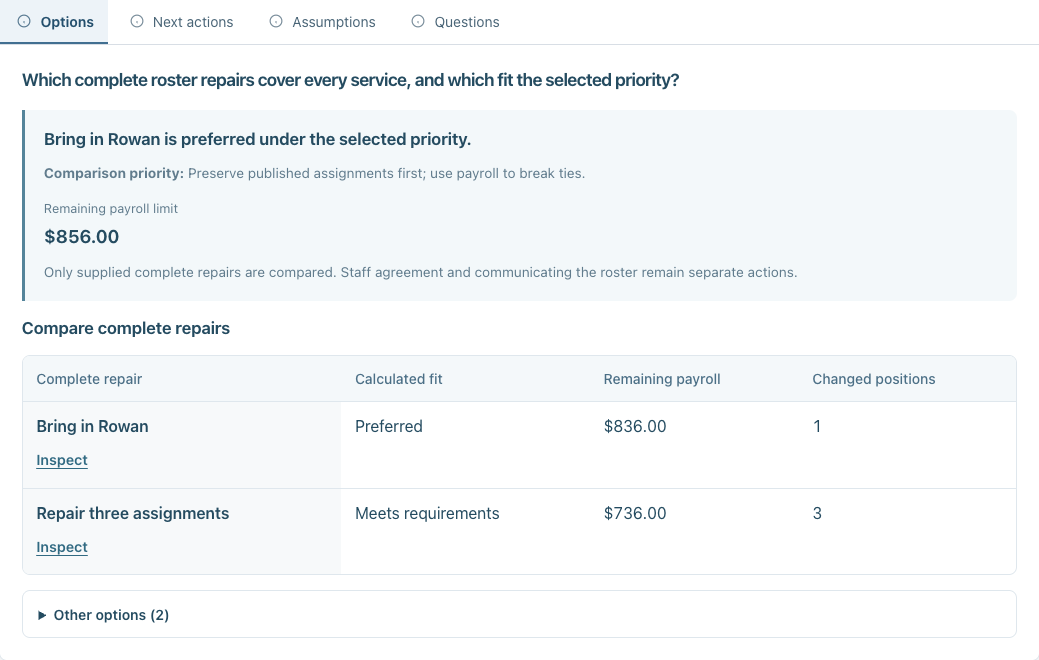
Preserve published assignments first.
Rowan is preferred: one changed position and $836 remaining payroll.
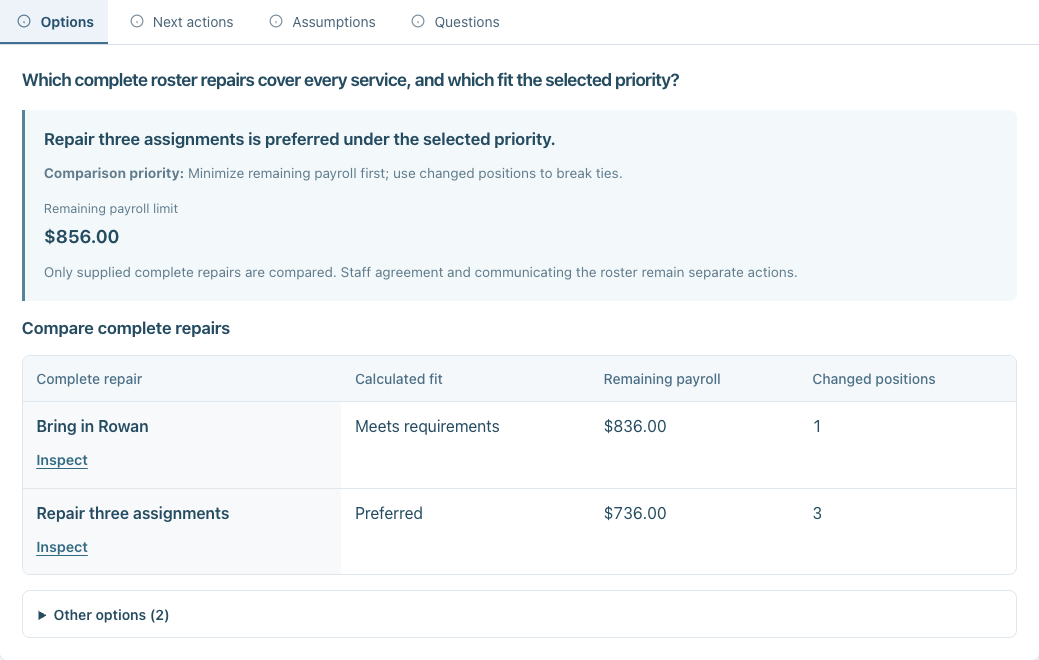
Minimize remaining payroll first.
The coordinated repair is preferred: three changed positions and $736 remaining payroll.
The preference changes because the authored priority changes. It does not establish that either priority is universally right. In both reports, the preferred repair is preferred among the four supplied candidates; the app has not searched every possible restaurant roster.
The $100 difference becomes a decision Elena can discuss.
For this already-published week, Elena chooses the stability-first priority. She is willing to spend $100 more than the coordinated repair to avoid two additional changed positions. Bringing in Rowan gives $836 remaining payroll, within the $856 limit.
That is Elena’s management judgment. Decision Lab makes the tradeoff explicit and applies the declared order consistently. It does not assign a monetary value to employee inconvenience or establish the fairness of the resulting week.
Elena can now explain the proposal to the owner and team: the required services remain covered under the supplied records, the other published assignments are preserved, and the extra expense fits the recorded boundary. She obtains Rowan’s agreement and communicates the change through the restaurant’s usual process. The calculation does not contact Rowan, record agreement or publish a roster.
If Rowan cannot accept the complete shift, Elena has a reason to return to the analysis rather than treating the preferred label as a reservation. She updates the availability, applies the inputs and recalculates. A priority can order passing repairs; it cannot repair a failed condition.
The Complete a Commitment assessment preserves the same coverage, compatibility and expense requirements under either priority. The preference rule orders the supported options; it cannot make Rowan available after 8 p.m. That is the reusable distinction Elena can apply to the next roster decision.