
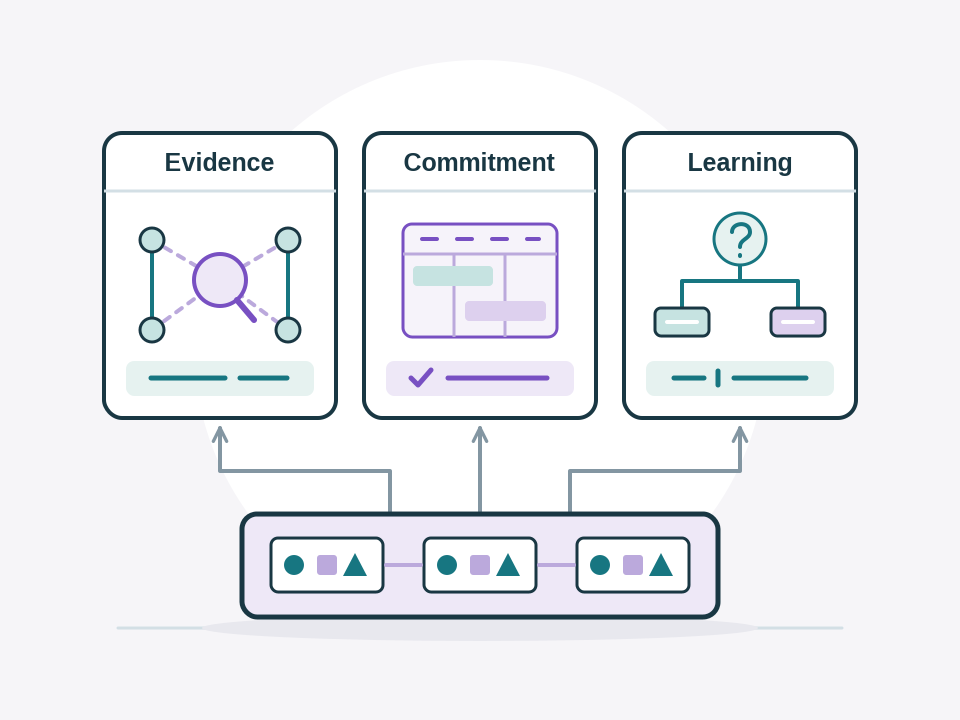
Maya needs to decide whether to buy a registration check before reserving freight. Three questions sit inside that decision. What do the existing records establish? Which complete shipment plans meet the requirements? Would another check improve the outcome enough to justify its cost and delay?
Each question can involve examining complete combinations. Each also needs a different kind of judgment. A possible explanation of the records, a workable shipment plan and a worthwhile investigation establish different things.
The arrangement framework gives us a way to construct and examine possibilities. An assessment pattern specifies what those possibilities mean and what judgment their evaluation supports.
What an arrangement contributes
In The Arrangement Problem, we describe an arrangement as a complete candidate combination within a stated model. It binds the relevant choices and relationships together so that their joint compatibility can be examined. A supplier, a trial method and a production slot can each look suitable while their combination fails the deadline.
“Complete” describes the candidate’s structure: it supplies the choices and dependencies required by the model. Whether the candidate satisfies the requirements is another question. Whether the assessment has examined enough alternatives to support its conclusion is another again.
Operating plans are one use of that structure. An arrangement can also represent an interpretation of fixed evidence, or an investigation together with responses to its possible results. Its role depends on the question being assessed.
Specify the assessment before drawing a conclusion
We use assessment pattern for a reusable specification of a bounded assessment. It states the recurring question, what remains fixed, what may vary, what a candidate represents, which candidates are admissible and how their evaluation supports a conclusion. It also states the coverage and assumptions that conclusion requires.
This makes the step from constructing combinations to using them explicit. Finding one compatible interpretation may establish that the evidence has a possible explanation. Establishing an answer from that evidence can require ruling out every admissible interpretation that changes the answer. Finding one feasible plan, by contrast, can supply a witness that a modeled commitment is achievable.
| Part of the approach | Contribution |
|---|---|
| Foundations | Ontologies preserve meanings; phrase patterns express relationships; requirements define conditions; reasoning modules organize evaluation. |
| Arrangement framework | Constructs complete candidate bindings and examines their joint compatibility. |
| Assessment pattern | Defines the recurring question, candidate meaning, assessment method and limits of the conclusion. |
| Domain application | Supplies concrete entities, records, constraints, numerical models and justified mappings. |
| Domain process | Connects assessments and findings to further questions, available responses and responsible action. |
This is an explanatory order. When designing an application, we work backward from the outcome and the question people need answered. That question determines which assessment is appropriate and which arrangements, definitions and records it requires.
Each assessment pattern also includes reusable decision points: what different findings establish, what remains unresolved and which responses become relevant. A business workflow specializes those points with its records, responsible people and authorized actions. An assessment can support the next decision without making that decision on someone’s behalf.
Three questions, three meanings
| Assessment question | What a candidate represents | What the evaluation examines |
|---|---|---|
| What must the evidence establish? | A possible interpretation of fixed evidence. | Consistency and whether admissible interpretations change the required answer. |
| Can we complete the commitment? | A complete selectable operating plan. | Whether its obligations hold under the declared operating and uncertainty conditions. |
| What is a question worth? | An investigation with responses to its possible results. | Its modeled net outcome relative to the best available outside option. |
Evidence: which conclusions survive the interpretations?
Suppose observations could belong to the same event or to separate events. The evidence assessment holds the supplied observations fixed while examining the interpretations allowed by the model. The person using the assessment does not get to select whichever explanation makes a preferred plan easier.
An established answer requires a consistent basis and sufficient coverage to show that no admissible interpretation changes that answer. If admissible interpretations disagree, the question remains open under that basis. If a completed check establishes that no admissible interpretation remains, the assessment exposes a problem in the represented evidence or assumptions. A count of interpretations alone supplies no probability for them.
Which Observations Can Fit the Same Explanation? develops the interpretation example. In the gift-kit correction case, the evidence assessment establishes which faults the recorded observations support; planning then uses those scoped findings to assess complete corrections.
Develop this assessment from its starting question in What Must the Evidence Establish?
Commitment: which complete plan can meet the requirements?
Here the candidate represents something people could choose to do. The assessment checks the complete assignment of work, timing, resources and recorded permissions against the modeled obligations. Where uncertainty is represented by admitted scenarios, the candidate must meet those obligations across those scenarios.
In the restaurant roster case, a repair must cover both the Saturday dinner gap and any Sunday gap created by moving a cook. The assessment checks four supplied repairs. A feasible repair establishes a way to meet the modeled conditions within that candidate set. A separate priority is needed to prefer one feasible repair over another.
The broader arrangement idea can include a conditional policy: what to do after different observations. The current public Commitment Planner evaluates static complete arrangements whose operating choices are fixed before its admitted scenarios. Its findings should be read within that supported scope.
Develop this assessment from its starting question in Can We Complete the Commitment?
Information value: would learning change what we should do?
An investigation is useful through the responses it makes possible. This assessment combines a study with a response to each possible report, then compares its modeled net outcome with the best available option without that study. Study cost, reporting time, response feasibility, probabilities and payoffs all matter.
In the Python shipment example, an estimate of registration feeds a study-and-response comparison. A timely check can let Maya use cheaper freight when registration is confirmed and retain a supported fallback otherwise. The same check can lose its advantage when its fee rises or its result arrives too late to act.
The supported learning pattern evaluates one optional study and responses to its possible reports under explicit numerical assumptions. Its current objective compares expected monetary outcomes. A reduction in uncertainty alone does not establish business value; the information must improve the modeled decision enough to cover what obtaining and using it costs.
Develop this assessment from its starting question in What Is a Question Worth?
How assessment patterns fit our pattern language
Our shared-structure convention distinguishes an overall decision pattern from its supporting reasoning patterns. Workflows put decision patterns into practice; configured apps apply supported reasoning patterns. An assessment pattern specifies a recurring supporting assessment within that account, including what its conclusion means.
For Maya, an overall decision pattern can organize a shipment commitment: establish the relevant facts, compare complete plans, consider whether another check is worthwhile and put forward a supported proposal. A workflow can connect those questions. The shipment integration demonstrates planning and learning; the gifting example demonstrates evidence feeding planning. Each app performs its supported assessment with domain definitions and rules.
One decision pattern can use several assessments. The same assessment pattern can also support different decisions. Shipment planning and roster repair share the need to check complete operating arrangements, while using different entities, requirements and priorities. Our Pattern Languages article explains how these reusable approaches connect and adapt to context.
Preserve meaning when findings travel
Composing assessments requires compatible meanings. A finding that a registration record concerns one order revision cannot silently support another revision. A feasible correction schedule leaves the correction unperformed. A modeled benefit from buying a check leaves its actual result unknown.
A handoff therefore needs the conclusion together with its scope, assumptions, source basis, coverage and outstanding conditions. The receiving assessment must require what that result actually establishes. This is the practical connection to computational hermeneutics: examine whether a result preserves the meaning another part of the decision relies on.
Maya’s outcome is a proposal she can justify: which freight to put forward, whether to obtain another check and what must still happen before shipment. The assessment patterns make the basis of that proposal inspectable. The domain process connects it to the people and systems that obtain confirmation, authorize spending and reserve the freight.
To practice the mapping, explore the named Patterns catalog and predict the findings in Explore a Disrupted Commitment. The exercise holds one release baseline fixed, changes one fact at a time and then asks which relationships transfer to a restaurant roster. A changed build qualification is a scoped requirement check; it does not automatically call for the formal evidence assessment.