
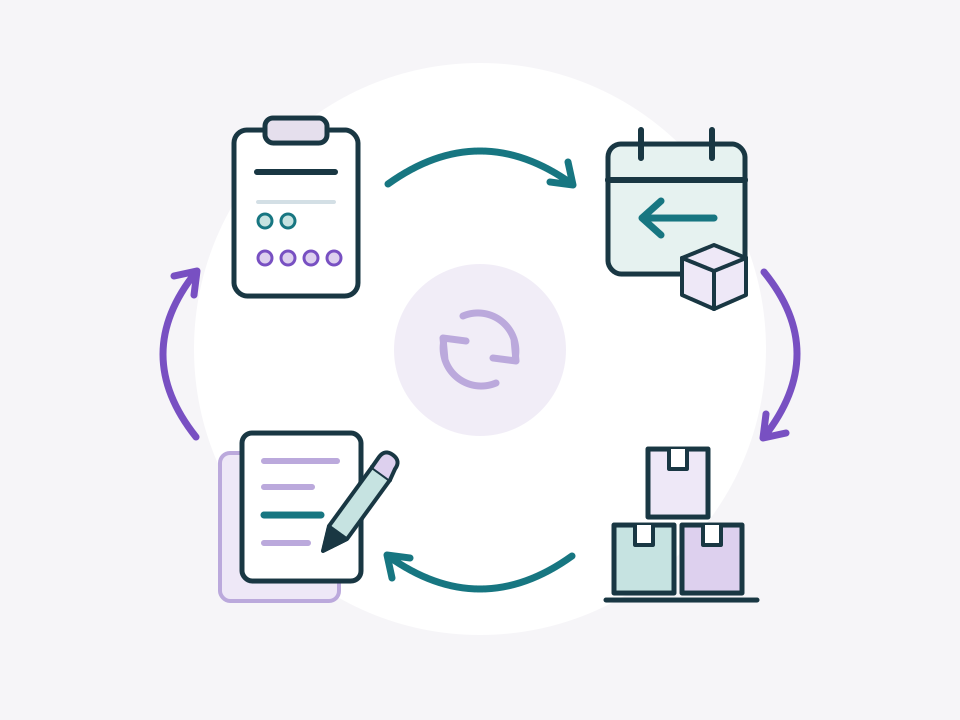
Suppose a supplier change was approved on the expectation that incoming inspection would take two days. After several deliveries, inspection regularly takes four. The production schedule still assumes two, so material repeatedly misses its reserved slot. The decision now needs a way to respond to what people have learned through carrying it out.
In the previous article, we described systems engineering as bringing the parts together around a desired outcome. Feedback loops help maintain that connection as the system operates. They connect what happens after a decision to what people do next, including whether they continue, adjust, investigate, or reconsider the arrangement.
Feedback occurs when the effects of an activity return through a causal path to influence that activity’s future behavior. In a deliberate decision process, observations inform interpretation, interpretation informs a response, and the consequences of that response become available for further observation. The connection back to action makes the loop consequential.
Karl Johan Åström and Richard Murray describe sensing, computation, and actuation as central elements of feedback control in Feedback Systems. For the decisions we study, people may perform the interpretation and choose the response. Our interest is in making those relationships explicit enough that people can examine how the loop works.
Interpret the observation before choosing a response
The supplier example begins with a comparison between an expectation and an observation. To make that comparison useful, we need to identify what “inspection takes four days” means. Does the interval begin when material arrives, when its documents are complete, or when an inspector starts work? Different definitions can produce different conclusions about the same delivery.
This is where the earlier work on ontology and interpretation becomes practical. A receipt date, a review completion date, and an authorization to use material describe different events. A decision model needs to preserve those distinctions if it is going to help someone understand where the delay occurs.
The difference between two days and four also needs explanation. Additional testing, incomplete supplier documents, or competition for inspection capacity could each contribute. An observation can establish that the planning assumption needs attention while leaving the cause unresolved. The response should reflect what the available evidence supports.
The information then needs to reach someone able to act on it. That person needs an account of the affected commitments, the available responses, and the authority required to make a change. A useful loop connects the observation to a responsible decision and a subsequent assessment of its consequences.
One response might be to arrange earlier deliveries while investigating the inspection delay. That change could reduce missed production slots but increase inventory and storage costs. The next review should examine both effects against the intended outcome. The response becomes another decision whose assumptions and consequences can be assessed.
Distinguish balancing and reinforcing loops
Feedback can either oppose a change or reinforce it. Donella Meadows describes these different structures in her discussion of places to intervene in a system. Balancing, or negative, feedback tends to counter a deviation. Reinforcing, or positive, feedback tends to amplify a change. These names describe the direction of the effect rather than whether people welcome it.
A balancing loop might respond to a growing inspection backlog by assigning additional qualified capacity. If that capacity clears work faster than new work arrives, the backlog falls and the need for additional capacity diminishes. Whether the response works depends on the resources available and how the inspection process actually behaves.
A reinforcing loop could arise if a growing backlog creates pressure to rush, rushed work causes more errors, and correcting those errors adds to the backlog. That is a possible causal explanation to investigate. Identifying it would direct attention toward the relationships sustaining the problem, including whether the attempted response is making it worse.
Assess timing, response size, and results
Timing changes the behavior of a loop. There may be delays before a problem is observed, before information reaches the decision maker, and before a response has an effect. Meadows emphasizes the importance of delays relative to how quickly a system changes. A response based on an old situation can be poorly matched to the situation it eventually affects.
For example, repeated shortage reports might prompt additional orders while earlier orders are still in transit. When the outstanding deliveries arrive together, the response can leave the organization with excess inventory. The purchasing decision needs visibility into commitments already made and the time they require to take effect.
The size of a response matters as well. Changing suppliers after one unusual delivery may create unnecessary disruption; ignoring repeated delays may leave an unsuitable plan in place. People need to assess variation, the consequences of waiting, and how reversible the available responses are. Feedback requires judgment about when and how much to act.
An improvement after a change also needs interpretation. If inspection becomes faster after adding staff, the arriving batches may also have become smaller or their documentation more complete. Recording those conditions helps people assess the explanation. Comparable cases or a suitable test may help distinguish the effects of the response from other changes.
The measure used to guide the loop deserves examination too. Increasing the number of batches cleared each day could appear successful while incomplete checks create problems in production. For our supplier decision, inspection speed belongs alongside material conformity, production disruption, and total cost. The measures need to remain connected to the outcome people intended.
Reconsider actions, assumptions, and decision rules
Feedback can change the action, the model, or the rules used to make decisions. Moving a delivery changes an operational choice. Revising the expected inspection duration changes a planning assumption. Reconsidering a policy that rewards purchase-price savings without accounting for downstream costs changes how proposals are evaluated.
Chris Argyris’s single-loop and double-loop learning distinguishes adjusting actions within existing assumptions from examining those assumptions themselves.
At Hermod Labs, we want people to be able to question the framing of the decision as experience accumulates. A series of scheduling adjustments might eventually lead the team to reconsider whether the supplier change still serves the original cost and delivery goals. Revisions to those goals or commitments should remain explicit and accountable to the people concerned.
Preserve the history and follow affected conclusions
The history of the reasoning matters. We want to preserve what was expected, what was observed, which interpretation was adopted, and why a response was chosen. Replacing the old estimate with a new number would lose part of that history. Retaining it helps people understand what changed and evaluate the next prediction.
Reasoning modules provide places to examine the consequences of new evidence. A revised inspection estimate may affect a scheduling conclusion, which may affect a delivery commitment and the financial assessment of an arrangement. Following those dependencies helps people identify which conclusions need another look while preserving findings whose scope remains unaffected.
Different questions also need different review periods. A daily operational problem may require a prompt response, while judging a supplier’s overall suitability may require evidence from several deliveries. Connecting these reviews lets local observations inform broader decisions without treating every fluctuation as a reason to redesign the whole system.
In a Decision Lab application, supplied observations and explicit dependencies define what a recalculation can establish. The surrounding process supplies updated records and determines when to recalculate. People can compare the findings, inspect the evidence, assess possible explanations and choose a response with its consequences in view.
Feedback makes a decision model something people can learn with over time. We work backward from the desired outcome, act on an arrangement supported by the available evidence, and bring the resulting experience back into the reasoning. Our goal is to help humans maintain and improve their understanding of the systems they are trying to shape.