
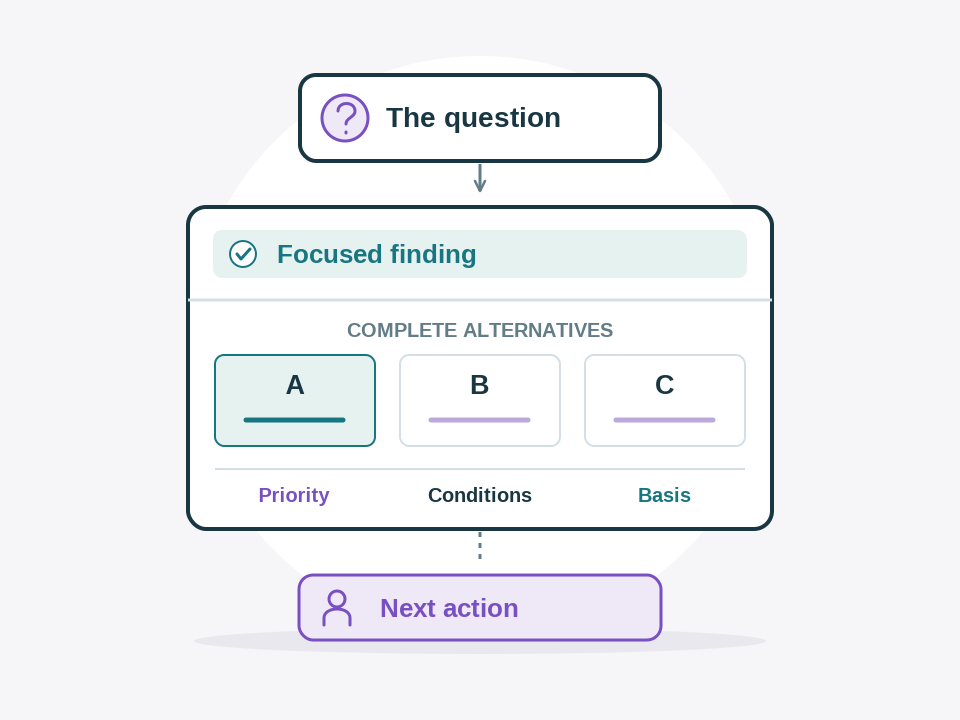
Maya has a revised shipment to arrange before its booking window closes. A cheaper quote is useful only if it covers the complete order and meets the current requirements. A report needs to let her see which response is supported, why, and what remains for someone to do.
Reading that report starts with what it has established, what supports the finding and what remains unresolved. The same questions apply to a spreadsheet, an analyst’s recommendation or an application.
Identify the claim before acting on it.
A freight price leaves open capacity, timing, current confirmation and spending authority. Maya needs complete alternatives that can be assessed together. We call one such complete combination an arrangement.
The commitment assessment asks whether an arrangement meets its recorded obligations. The report presents that finding and gives Maya a route to its basis. A common heading or attractive display cannot change what the assessment establishes.
Ask six questions of the report.
| Question | What to look for |
|---|---|
| What has been established? | A bounded conclusion, with a current and sufficiently evaluated calculation. |
| Which alternatives fit? | Complete candidates and the mandatory conditions each meets or fails. |
| Why prefer one? | The declared comparison policy, including ties or the absence of an established preference. |
| What qualifies the finding? | Failed requirements distinguished from missing inputs, incomplete evaluation and conditional assumptions. |
| What supports it? | The relevant records, revision, time window and assumptions behind a consequential check. |
| What remains to do? | The available response and any separate choice, authorization or actual work still required. |
A fully checked passing candidate can establish a feasible option while the wider comparison remains unfinished. Establishing that none fits, or that one is preferred, needs sufficient comparison coverage or another sound proof. The report should preserve those differences.
Read the same shipment before and after new evidence.
In this fictional continuation, Maya’s order requires 100 units and has a $5,000 expense limit. Direct has capacity for only 99 units. Backup costs $6,000. Consolidated fits the capacity and expense requirements, but its confirmation covers the previous order revision.
Now the carrier supplies a genuine confirmation for the current revision and required loading interval. Only that scoped record changes. Read the two summaries using the questions above:
Confirmation covers the old revision.
None of the three supplied arrangements meets every requirement. Consolidated lacks current confirmation; the other options fail different conditions.
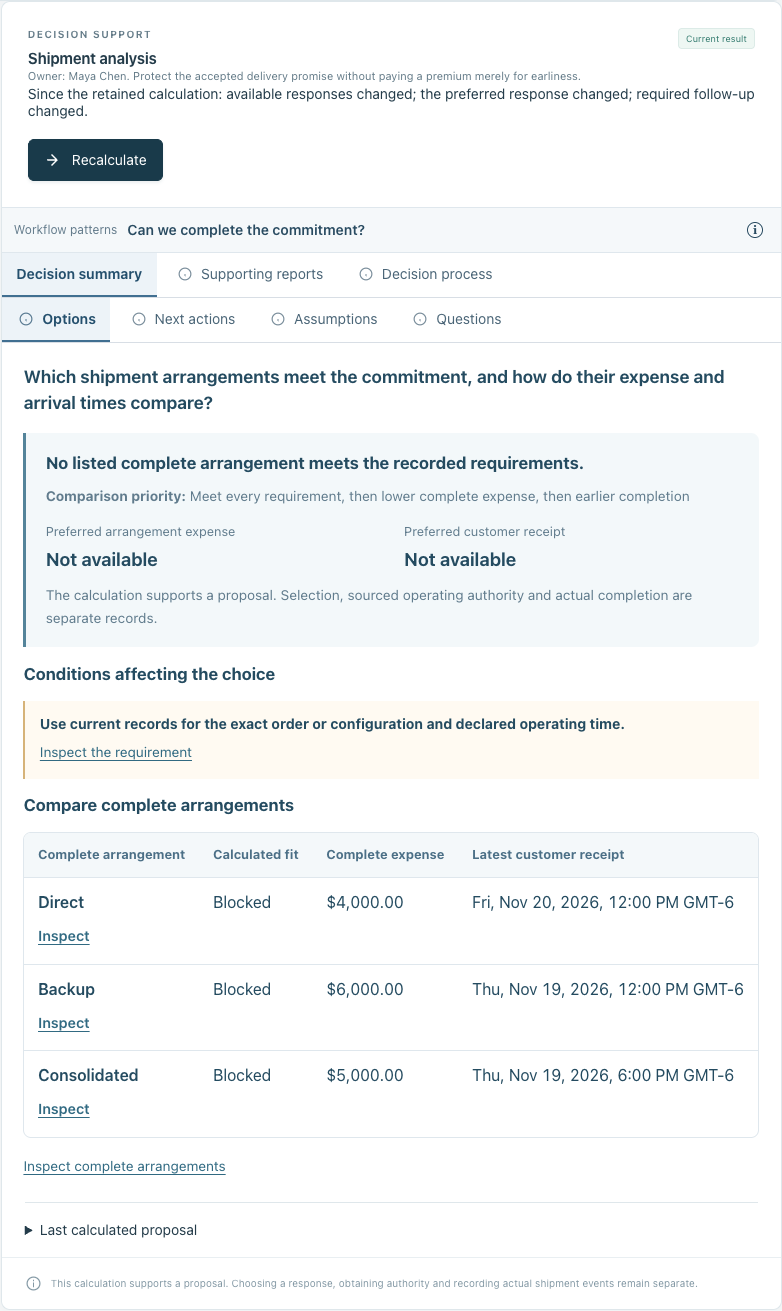
New confirmation covers the current revision.
Consolidated is preferred at $5,000, arriving Thursday at 6 p.m. Direct’s capacity and Backup’s expense failures remain.
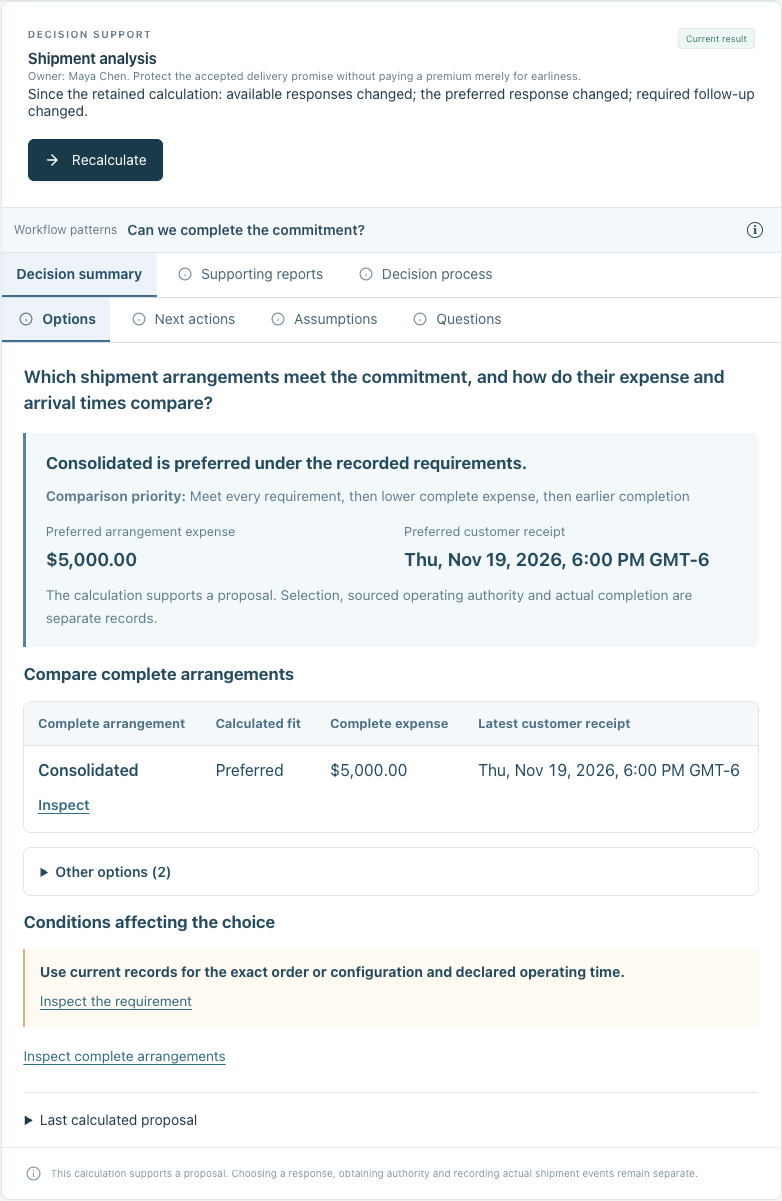
The headline changes because its factual basis changes. In the supporting reports, Maya can inspect the confirmation’s order revision, shipment scope and validity interval. Rewording an old record or choosing another report tab would supply none of that evidence. Follow the shipment exception to see how the same case continues from the company’s intervention queue.
Keep uncertainty, preference and action separate.
An unavailable answer differs from established infeasibility. Missing inputs, an incomplete evaluation or a stale calculation can prevent a conclusion. Here the completed assessment establishes that no supplied candidate passes before the new confirmation. That supports reconsidering a specific record, requirement or response; an unexplained empty display would not.
A supported option differs from an established preference. A passing arrangement meets the mandatory conditions. A declared policy and sufficient comparison can establish which supported option comes first. Which Feasible Option Should We Prefer? shows how different priorities change a recommendation while the operating facts stay fixed.
A proposal differs from work performed. The current confirmation supports Consolidated’s eligibility. It does not establish that Maya authorized the spending, reserved the carrier or received the goods. Those actions need their own people, processes and records.
Use the finding to identify a specific next response.
Maya can now explain why the old confirmation blocked the proposal and why the newly scoped record changes it. She can put forward the $5,000 arrangement with its requirements visible. If another relevant fact changes, its dependent findings need recalculation before she relies on them again.
That is the practical test of a report: can its reader explain the conclusion, its limits and the next responsible action? What Does Choosing an Arrangement Commit Us To? follows the distinction between a supported proposal and an operating commitment.